
- Published
- Nov 6, 2026
- Reading time
- 10 min read
Ad Tracking Blocked by CSP? Trace the Failing Resource
Diagnose CSP-related ad and analytics failures with resource-level evidence, effective policy checks, product-specific setup and a controlled retest.
In this guide (9 sections)
If ads or analytics stop after a Content Security Policy change, capture the actual blocked resource, its document or frame, the effective directive and whether the policy is enforced. Then compare the implementation with the current instructions for the specific tag. A loaded container does not prove that its downstream measurement requests are allowed, and a console warning near an unfilled ad does not establish causation.
Keep the existing security requirement in the acceptance criteria. The task is to identify a compatible, approved implementation and verify its delivery path, rather than remove protection until a dashboard total rises.
An older GAM/AdSense publisher question asks whether to maintain a domain list or use a nonce. A separate ad-delivery discussion reports unfilled slots alongside an unrecognized-directive warning. The replies do not establish the actual failing resource or a verified repair. These are historical troubleshooting questions, not evidence of a current platform outage.
Start with a reproducible action and an expected resource#
Write one test case before opening a list of red console messages. Identify the route, action, approved consent state, intended tag and receiving destination. Include site release and tag-container versions, browser, test time and timezone.
For a publisher, the sequence might include an ad request, the selected creative, rendering and separately configured measurement. For an advertiser, it might include an accepted test lead, a tag decision, an outgoing event and destination processing. Those sequences have different owners and checkpoints.
The marketing tracking QA checklist defines the broader journey. For this investigation, add the resource that should appear at the first missing boundary. If nobody can identify that resource or its supported event, a generic “CSP broke tracking” label is premature.
Use a restricted test reference rather than personal data. Network captures can contain identifiers and business information; share a minimal relevant extract with the authorized implementation owner.
Test the complete measurement handoff.
Place the policy observation beside a defined journey, expected event and receiver receipt.
Use the tracking QA checklistOpens a practical guide. No email required.
Separate a policy warning from an enforced block#
Read the complete browser message. Save the resource URL or redacted origin, the named directive, source document/frame and reported disposition. Keep surrounding errors for context, but do not merge them into a single cause.
Chrome's Issues panel documentation explains how to inspect affected resources and move into the relevant browser context. Use that association to connect a violation with the tag or creative under investigation. A message count alone cannot make the connection.
The older ad-delivery question mentions an unrecognized prefetch-src directive and an unfilled slot. That warning does not by itself identify a blocked ad request. Ask for a specific enforced violation and the expected resource before choosing a policy edit. An unfilled response can also require an eligibility or delivery investigation.
| Observation | What to retain | What remains unresolved |
|---|---|---|
| A directive warning | Exact text and affected document | Whether any required resource was blocked |
| An enforced resource violation | URL, directive, policy source and test action | Whether this explains the selected measurement gap |
| A report-only violation | Disposition and proposed-policy version | Whether a separate enforced policy blocked the action |
| Resource returned successfully | Request and response context | Execution, event validity and receiving-report inclusion |
| No expected resource appears | Trigger, consent and initialization evidence | Whether the integration attempted it at all |
Treat “not observed” and “blocked” as different statuses. A tag that never initializes may produce no request for the destination you were searching for.
Match the directive to the resource type#
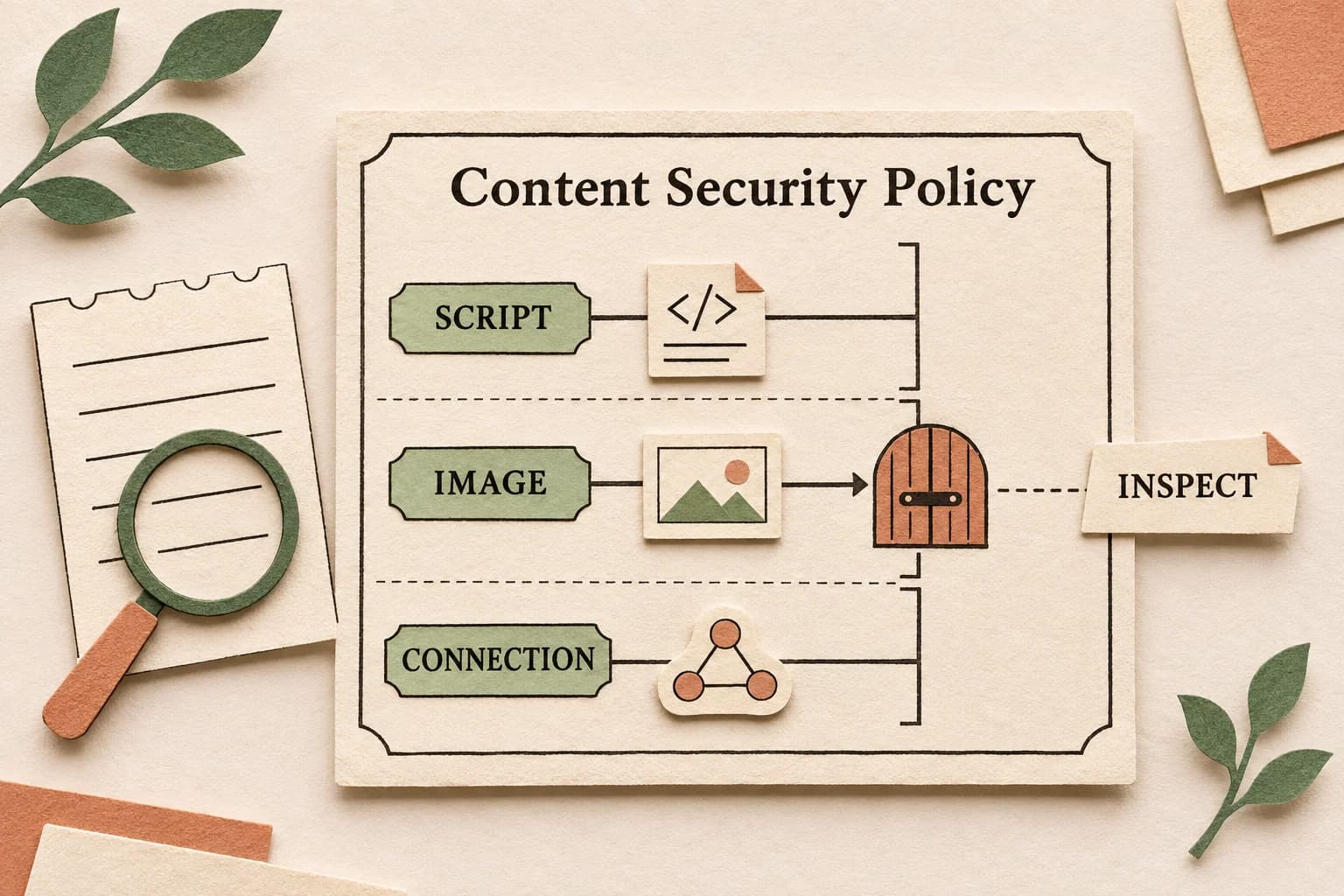
A script and its outgoing measurements can be governed by different directives. Adding one origin to a script list cannot establish that every associated image, connection or frame will be permitted.
| Resource or operation | Policy area to inspect | Supporting reference |
|---|---|---|
| Inline or external tag script | Effective script directives, nonce/hash and documented loader behavior | Google Tag Manager CSP setup |
| Image-based request | img-src and applicable fallback | MDN image sources |
fetch, XHR or sendBeacon | connect-src and applicable fallback | MDN connection sources |
| A nested frame loading a document | frame-src and its fallback chain | MDN frame sources |
| A framed document refusing its parent | The framed response's frame-ancestors | MDN allowed ancestors |
Record the directive actually named by the browser. MDN documents that connect-src and img-src can fall back to default-src when absent; frame-src has its own fallback chain. The allowed-ancestor check governs which parents may embed a document, rather than which frames your page may load.
This distinction determines who can investigate. A restriction returned by a third-party framed document is not necessarily controlled by the publisher's top-level header. Escalate the exact response and context to its owner instead of widening an unrelated directive.
CSP is also distinct from consent decisions, CORS, browser extensions and server responses. Preserve the reported failure category. Do not apply a CSP change to a request whose evidence points to a different boundary.
Inspect every policy the browser actually received#
Read the document response and relevant HTML metadata for the tested release. Compare that with the configuration file the developer intended to deploy. A CDN, proxy, application or template can leave the browser with more than one policy source.
In an older Stack Overflow question, the author found both header- and meta-delivered policies after an apparently ineffective connect-src edit. The accepted explanation's “override” wording should not become your implementation model. MDN's current multiple-policy reference explains that an additional enforced policy can further restrict the resource; a more permissive second policy does not relax an existing block.
Save a small provenance table:
- Which response or HTML element supplied each policy.
- Whether it was enforced or report-only.
- Which release or infrastructure layer owns it.
- Which policy and directive the observed failure names.
- Whether the inspected response is the released version or a stale/cached one.
A successful local configuration edit is not proof of the response served to visitors. Retain the effective browser evidence after deployment of any approved correction.
Treat report-only as an observation mode#
MDN's CSP deployment guide distinguishes enforced and report-only headers. Report-only reports its own violations without enforcing them. When both are present, an enforced policy still applies independently.
Therefore, a failed request while testing a report-only proposal does not prove that report-only blocked it. Inspect the other effective policy and other error categories. Conversely, a report-only warning is useful evidence of what a proposed policy would affect even when the resource presently loads.
Have the security owner define the intended test and review the collected violations. Keep the reporting endpoint and any captured request details within the organization's approved handling process. A list of every reported host is not automatically an approved allowlist.
Use the current product-specific integration instructions#
For GPT, Google's CSP integration guide supports strict CSP with nonces because its resource domains can change. It documents cross-domain creative rendering before slots load, and warns that some reservation creatives can depend on a same-domain environment. A static list copied from an old forum answer is not the current supported GPT setup.
For Tag Manager, Google's separate guide recommends a fresh, unpredictable server-generated nonce and a nonce-aware loader. It also lists additional requirements by tag and feature, including Analytics, Ads, Floodlight and Preview. Container execution is one checkpoint, not certification of every destination.
Those are distinct products and implementation instructions. Do not copy a GPT recipe into an advertiser's tag setup, or treat a working Tag Manager Preview session as acceptance of the production journey.
Ask the implementation owner to document which features are in scope and why each proposed permission is required. Use current official instructions when planning the change, and preserve the relevant documentation version or retrieval time with the review packet. Avoid a universal CSP header in a support answer: the correct policy also depends on the rest of the site's application and security design.
When the remaining question is creative/container compatibility, continue with the SafeFrame rendering and measurement audit. That guide owns renderer support and actual-container evidence; this one identifies the browser policy responsible for a resource-loading failure.
A hypothetical audit with honest denominators#
Suppose an authorized team tests twelve representative journeys after a site release. These invented figures illustrate evidence classification, not customer results.
| Journey result | Count | Next investigation |
|---|---|---|
| Intended resource observed, destination still to verify | 5 | Receiver and report checks |
| Confirmed enforced policy violation on the intended resource | 3 | Scoped implementation/policy review |
| Report-only warning, intended resource still observed | 2 | Proposed-policy review; separate destination check |
| Intended tag not triggered | 2 | Trigger, initialization or approved consent behavior |
| Total | 12 | Preserve all four outcomes |
Seven journeys have an observed intended resource: 5 + 2 = 7, or 7 / 12 = 58.3% of these test cells. Three have a confirmed policy block: 3 / 12 = 25%. Two did not reach the expected tag attempt.
It would be wrong to call all seven unsuccessful or unfinished reporting checks “CSP losses.” It would also be wrong to call the seven observed requests seven accepted leads. The test has not yet established destination processing or business qualification.
After an approved correction, rerun the three blocked cases and the neighboring passing cases. Keep the original and later results with their timestamps. A corrected test cell does not establish a site-wide recovery percentage, recovered attribution or refunded ad spend.
Close on the released journey, not the edited header#
A useful acceptance record names the first demonstrated failure, proposed correction, affected routes and expected retained controls. It should include both positive and negative cases: the intended measurement may proceed where approved, and disallowed behavior remains disallowed.
Retest relevant consent choices, route transitions, reloads, device layouts and creative paths. Verify the actual response policy and observed resource, then inspect the destination using the supported diagnostics and reporting definition. Where a receiving report needs processing time, preserve the extraction time and do a bounded recheck.
The successful requests but missing data guide covers the later receiving/reporting investigation. For a publisher's unfilled delivery question, keep eligibility and response evidence separate from a browser block. One symptom should not overwrite another.
For independent campaign evidence alongside that work, request an AdProof demo and agree on campaign, date range, timezone, event definitions and available scoped exports. Keep browser headers, tag configuration and destination diagnostics with their owning teams. AdProof's campaign-report workflow does not imply automatic CSP repair, tag deployment or access to another platform's processing decisions. The anonymized fashion-retail duplicate-counting case concerns ad impressions rather than browser-policy repair; its counting scope should remain separate from this site-instrumentation test.
Frequently asked questions#
Does a loaded tag container prove that CSP is configured correctly?
No. Check the particular tag, feature and downstream resource involved in the journey. Container execution, outgoing transport and destination processing are separate observations.
Does a report-only message mean the resource was blocked?
Not by that report-only policy. Check the request and any separate enforced policy or other failure. Preserve the disposition rather than inferring it from the presence of a console message.
Should I add every blocked domain to the policy?
No. Identify the owner, purpose, required feature and supported integration first. Have the responsible implementation and security owners review a scoped proposal and test its effects.
Does fixing a policy violation recover all missing conversions?
That conclusion needs separate evidence. Verify the corrected journey and receiving system, then reconcile eligible reporting populations. A resource-loading correction alone does not prove attribution recovery or a particular business outcome.
Test the complete measurement handoff.
Place the policy observation beside a defined journey, expected event and receiver receipt.
Use the tracking QA checklistOpens a practical guide. No email required.