
- Published
- Oct 27, 2026
- Reading time
- 11 min read
Meta Ads Click-Fraud Tools: Check Prevention Before Paying
Evaluate Meta click-fraud tools by their evidence, intervention point, account access and false positives. Separate website protection from billing decisions.
In this guide (11 sections)
A click-fraud tool can help investigate suspicious visits or protect a website, but you need to establish exactly where it intervenes. A tool that classifies a visitor after the landing page loads has not, by that action alone, prevented an earlier ad interaction or changed Meta's billing decision.
Before paying, ask for three separate demonstrations: what the tool observed, what action it actually enforced, and what evidence connects that action to the cost or business outcome you want to improve. Do not accept one “blocked fraud” number as proof of all three.
This question appears in an October 2026 advertiser discussion about click-fraud platforms: can a tool reduce costs so the advertiser is not charged for bot clicks? An older, separate discussion about Meta traffic protection asks whether website blocking also improves later traffic. These are recurring questions, not verified campaign diagnoses or fresh platform announcements. Their recommendations include commercially interested claims that need independent checks.
Start with the charge you are trying to change#
Open the affected campaign's actual settings and exports. Record the delivery objective, selected performance goal, the event used for charging where exposed, spend, reporting interval and the exact click metric. Meta's Ad Set reference separates billing_event from optimization_goal, describing impression and link-click charging events. That does not mean every option is available to every account. A dashboard's CPC is a cost-per-reported-click calculation; that label alone does not establish the charging event.
Keep three questions separate:
| Question | Evidence needed |
|---|---|
| Did unwanted traffic reach the website? | Matched arrival logs, detector coverage and reasoned classifications |
| Did a control prevent a defined downstream action? | The enforcement decision, its timestamp and the request or event it stopped |
| Was an ad charge excluded or corrected? | The applicable platform determination and corresponding billing record |
Confirm what your account actually supports before accepting a vendor's statement about prevention or reimbursement. A website firewall decision and a platform billing determination are different records, even if they refer to related activity.
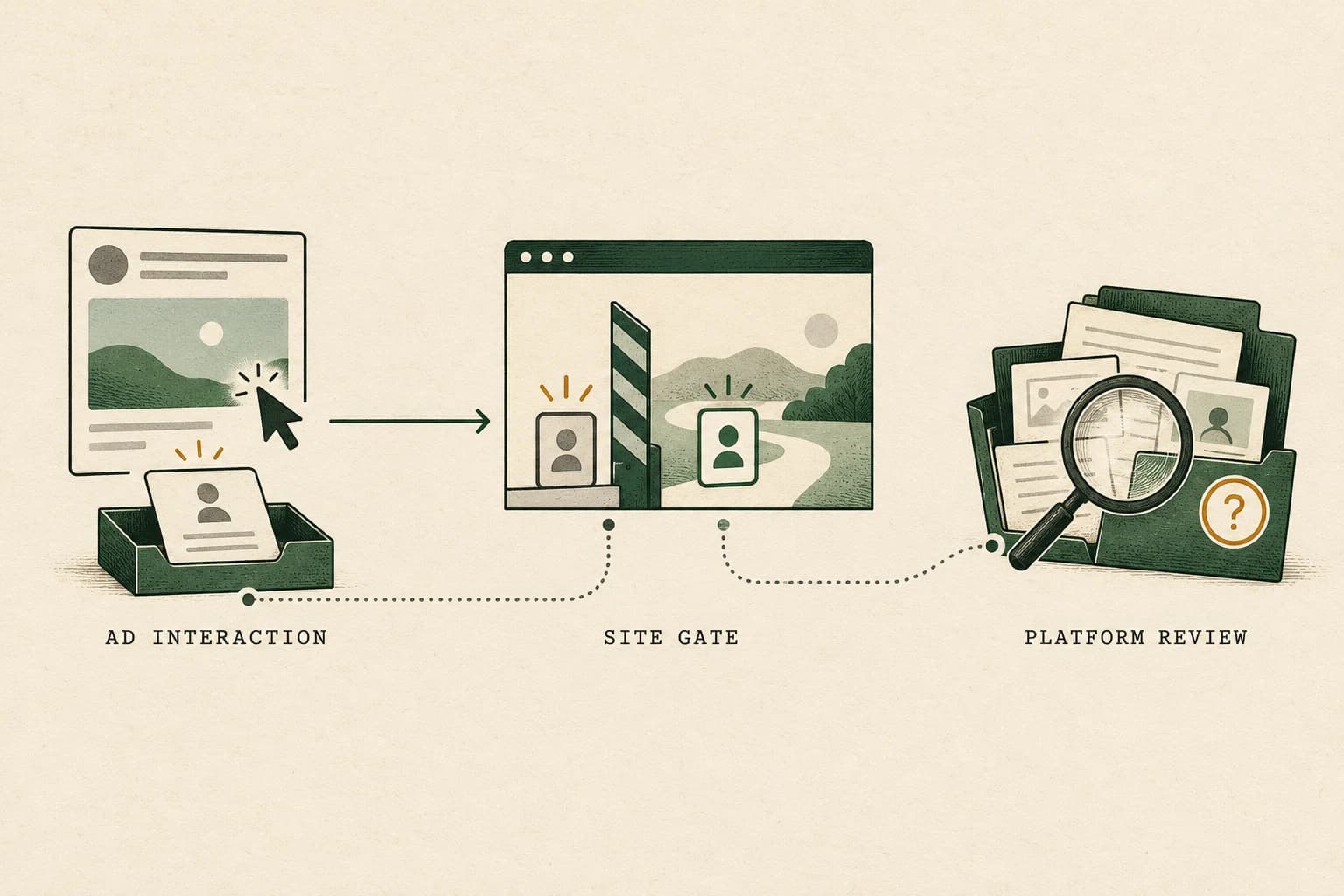
Locate the control in the click path.
A post-click signal and a prevented charge are different outcomes.
Discuss traffic measurementA measurement discussion, with scope confirmed before any next step.
What Meta's invalid-click policy establishes#
Meta's official detection and prevention of invalid clicks describes both non-genuine or repetitive/accidental clicks and activity generated through prohibited means, including bots and fake accounts. It says suspicious or potentially invalid activity that it detects or is alerted to receives manual review, and that advertisers are not charged for clicks determined to be invalid.
The qualifying step matters: Meta's determination of invalidity is not the same as a third-party tool's label. The policy does not make every short visit, analytics anomaly or vendor-flagged request a reimbursable click. Nor does this article infer a credit amount or review outcome for an impression-based charge from a count of suspicious website visits.
Preserve the relevant account and billing evidence if you seek a review. Treat the case as unresolved until there is a documented determination and, where applicable, an identifiable adjustment. Do not describe a request for review as money recovered.
Map the tool onto the actual event sequence#
Use this working sequence, then adapt it to your integration:
ad interaction → destination request → website decision → page activity → business action → platform reporting/review
This is a diagnostic model, not a claim that every Meta ad format follows a website journey. On-platform forms and other destinations need their own path.
| Intervention point | A tool might demonstrate | It does not establish by itself |
|---|---|---|
| After analytics receives an event | A suspicious pattern in measured activity | The original interaction was invalid or uncharged |
| At the website edge | A request was allowed, challenged or denied | The earlier ad record was reversed |
| Before a form is accepted | A specific submission was rejected | Every rejected submission was automated |
| Before an optimization event is sent | An event was withheld under a defined rule | A guaranteed improvement in future delivery |
| Through an authorized campaign control | A documented campaign setting changed | All earlier activity stopped or was credited |
| Platform review | A determination about submitted activity | A particular financial result without its billing evidence |
The prevention boundary follows from timing. If the decision occurs after the ad interaction, it can protect a later website action; it cannot be described as having stopped that earlier interaction without another verified mechanism.
Ask vendors for a short, testable specification#
Request written answers rather than a branded feature name:
- Coverage: Which destinations, devices and traffic paths are measured? What is invisible when a script is blocked or the page never loads?
- Decision: What does a label mean, and which reason codes or evidence can you inspect? How is uncertain traffic represented?
- Action: Does the product log, challenge, deny, suppress a particular event, or change a campaign? Which action is automatic?
- Timing: Can it act on the first visit? What information must exist before it decides, and how long does enforcement take?
- Authority: Which documented Meta control or account permission is used for any campaign-level claim? Ask to see the resulting account change.
- False positives: How can legitimate customers be reviewed and restored? Is there a narrow rollback?
- Billing evidence: Does the vendor prepare a packet, submit a review, or claim a financial adjustment? What independently verifies completion?
- Price basis: Are charges based on sessions, requests, domains, events or spend? What counts toward limits, overages and minimum terms?
Do not give a provider broad account access merely to view a report. Start with the access its demonstrated function requires, inspect the permission list, and keep an owner-controlled revocation path. A report-only service should explain why it needs mutation rights if it requests them. Never share an account password as a substitute for a supported authorization mechanism.
Test the first-visit claim#
A detector may need a page response, JavaScript execution or previous observations before it can classify a visitor. “Real time” does not answer which request receives the protection.
As one scoped example, Cloudflare's JavaScript Detections documentation says its relevant detection field should not gate a visitor's first request: at least one HTML request is needed before injection. It also separates a detection result from enforcement and notes legitimate reasons for a failed result. This describes that Cloudflare mechanism, not every bot product or Meta's ad system.
Ask your prospective tool to trace a fresh browser journey through the first destination request, decision, page load and form submission. Repeat on a returning visit. Save the action and its ordering relative to the event you intended to prevent. A detector that blocks only after the event was already sent needs a different integration or a narrower claim.
Keep website protection separate from campaign pausing. If automation can pause delivery, test its exact scope, evidence threshold, delay, approval mode and recovery procedure in an authorized limited test. A burst from one address is not a sufficient universal pause rule. A poorly scoped automation can disrupt legitimate campaigns while leaving the original billing question unanswered.
Use a matched evidence packet, not analytics screenshots alone#
Begin with the same completed period and account time zone. Export campaign and ad identifiers, the exact click column and spend. Compare those with destination arrivals where identifiers can be retained appropriately. Then inspect detector-covered visits and classifications.
For each suspicious segment, retain the minimum useful evidence: timestamp, landing path, available campaign context, request outcome, detector reason and enforcement action. Keep personal information and raw identifiers in restricted records rather than public screenshots. Log which records cannot be matched instead of assigning them to a campaign by guesswork.
Google's known-bot exclusion documentation says Analytics automatically excludes known bots and spiders and does not expose the excluded quantity. GA4 therefore should not be treated as a complete ledger of Meta's billed bot clicks. Low engagement, a data-center location or repeated activity can help select records for investigation; none supplies that ledger alone.
If the primary issue is missing sessions, follow the click-to-session diagnostic for general arrival, consent and tag checks. Its Google Ads-specific controls and billing rules do not transfer to Meta.
Worked example: a detector rate is not a savings rate#
These numbers are hypothetical. They demonstrate counting, not an actual Meta campaign or an AdProof customer result.
| Observation in one matched reporting interval | Count |
|---|---|
| Selected Meta link-click column | 1,000 |
| Website arrivals assigned to the comparison | 800 |
| Arrivals the detector could classify | 720 |
| Classified arrivals flagged suspicious | 90 |
| Flagged arrivals denied a later website action | 60 |
| Flagged arrivals allowed through | 30 |
The detector's flagged share is 90 / 720 = 12.5% of classified arrivals. Its classification coverage is 720 / 800 = 90% of the selected website arrivals. The remaining 80 arrivals are unclassified, not confirmed human traffic.
The 200-count click-to-arrival difference needs its own investigation. Clicks and arrivals can differ in definition, redirects, timing, matching coverage and collection. It cannot simply be added to the 90 flagged arrivals as fraud.
The 60 denials demonstrate a downstream action only if the enforcement logs substantiate them. They are not 60 prevented ad clicks. No credited amount appears in this example, and multiplying the 90 flags by average CPC would not establish money recovered. The numerator, denominator, action and financial determination each need their own evidence.
Measure whether protection hurts legitimate customers#
Before broad enforcement, use observation mode where available and review examples from both flagged and allowed populations. Include authorized test journeys across mobile browsers, in-app browser paths, returning users and shared-network environments relevant to your customers. Check page access, consent, form completion and actual accepted outcomes.
Use a short decision log: what was expected, what the tool decided, what evidence supports the classification, and whether the outcome can be resolved. A failed challenge is a technical outcome, not automatic proof of a bot. A completed form is not automatic proof of a genuine prospective customer either.
Compare equivalent populations over time. Record campaign, creative, placement, budget, offer and website changes alongside the experiment. A fall in flagged traffic after a rule change can reflect lost detector visibility or fewer arrivals. An improvement in lead quality may be useful, but it does not prove the tool caused Meta to change its audience.
Avoid the “block bots and retrain Meta in a week” promise#
Meta's attribution-model documentation distinguishes models and settings that affect delivery and conversion credit. It also warns against comparing results across ad sets using different attribution models without the appropriate comparison. Check the configuration actually active in your account.
A vendor should identify which event path it changes and what remains active: browser events, server events, on-platform actions or later qualified outcomes. Do not accept a promise that filtering one website signal guarantees a specific traffic-quality improvement or timeline. Require a controlled account-specific test with accepted business outcomes and the risk of suppressing genuine signals made visible.
For broader report interpretation, separate missing outcome records from attribution credit. Cleaner reporting, more restrictive traffic rules and improved business performance are separate claims.
Choose the next action from the evidence#
Buy investigation capability when you need auditable classifications. Buy website protection when a demonstrated gate addresses a downstream abuse problem. Seek a platform review when you have evidence relevant to its invalid-click policy. Evaluate campaign automation only when its supported control and safeguards are demonstrated. These functions can coexist, but a purchase decision should name which one you need.
For campaign-delivery measurement questions, discuss a supported verification scope with AdProof, bringing the dates, placement identifiers and comparable exports. Confirm coverage and integration first. Our anonymized fashion-retail delivery case concerns delivery scope, not Meta clicks or refunds. This does not imply an AdProof Meta account integration, click-blocking control, conversion-feedback service or refund guarantee.
Frequently asked questions#
Does a website block stop Meta charging for the original click?
The block alone does not establish that. It acts on a website request or later action. Verify the actual charge basis and any separate platform determination before claiming a financial effect.
Are all visits flagged by a third-party detector invalid clicks?
No. The detector applies its own definitions to the traffic it can inspect. Meta's policy refers to clicks it determines to be invalid. Preserve uncertain cases and check false positives.
Can I calculate savings from flagged visits multiplied by CPC?
That is not a verified saving. Flagged visits are not necessarily charged clicks, average CPC is not an event-level billing receipt, and a classification does not prove a credit. Use documented financial adjustments for a recovery claim.
Should I choose the cheapest tool with the highest bot rate?
Compare coverage, inspectable evidence, enforcement timing, access requirements, false positives and the complete price basis. A high flagged rate may reflect a different population or definition rather than better protection.
Locate the control in the click path.
A post-click signal and a prevented charge are different outcomes.
Discuss traffic measurementA measurement discussion, with scope confirmed before any next step.