
- Published
- Oct 25, 2026
- Reading time
- 14 min read
GAM vs DoubleVerify Geo Discrepancies: How to Investigate the Difference
GAM says in-target; DoubleVerify reports out-of-geo. Reconcile CTV location reports, unknowns, IP signals and geographic boundaries with an evidence checklist.
In this guide (13 sections)
Google Ad Manager says a campaign ran entirely in its target state. DoubleVerify flags impressions outside that state. One team suspects targeting; another blames IP databases. Neither explanation is established by the two totals.
Resolve the comparison in three stages: confirm both systems measured the same events, identify the location signal each received, and examine how each converted that signal into a geographic decision. This guide provides a worked example and a partner evidence request for doing that without treating an estimated location as a household address.
The problem appears in a GAM versus DoubleVerify CTV discussion and a separate CM360 city/postcode discrepancy question. These are reported experiences, not evidence that either vendor is generally inaccurate.
First distinguish a targeting rule from a location observation#
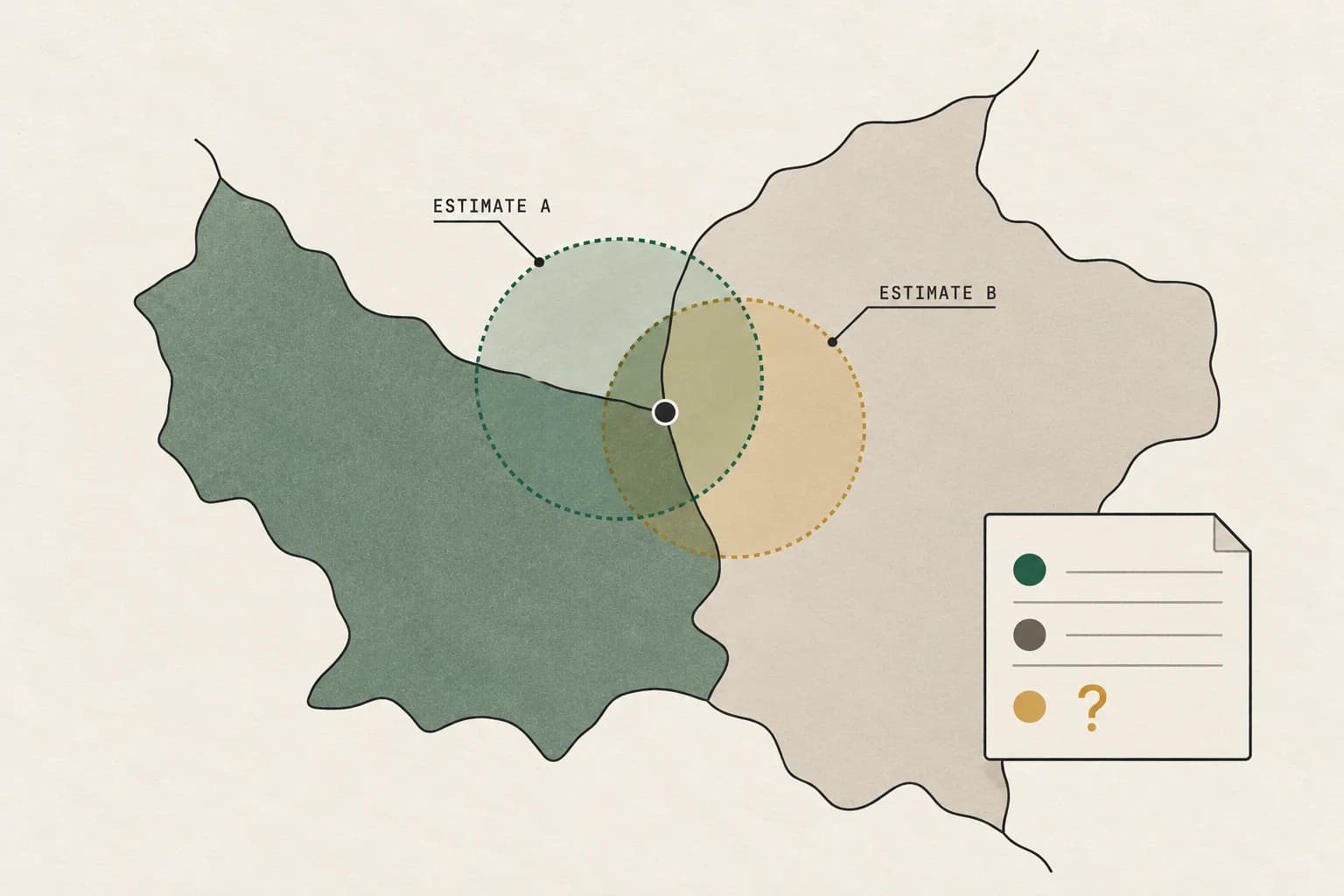
A targeting configuration tells an ad server which opportunities are eligible under its rules and available signals. A verification report describes how another measurement process classified observed events. The first is a decision; the second is an observation and classification. They can disagree even when the operators entered identical place names.
DoubleVerify's CTV measurement guide treats geographic relevance as a verification concern. It does not provide enough public integration detail to infer how a specific disputed event in your campaign was classified. Request that information through the vendor's supported investigation process.
Separate four possible findings:
| Finding | What evidence establishes it |
|---|---|
| Configuration error | An affected placement or deal did not use the agreed target/exclusion rules |
| Signal mismatch | Two systems received different location inputs for the same event |
| Classification disagreement | The same permitted input was assigned differently under two methodologies |
| Confirmed delivery outside agreed geography | Evidence sufficient under the agreed measurement policy and dispute terms |
The same campaign can contain more than one category. A real configuration error on one placement does not explain every other out-of-geo record. A database disagreement on another placement does not excuse the first error.
Align the geography each system measures
Different location signals can produce different results without proving a targeting failure. Discuss the fields and coverage available for comparison.
Discuss geo measurementA short inquiry to scope relevant options; no campaign access is needed.
Step 1: write the geography contract in plain language#
Before exchanging IP samples, document what “in target” means. Identify the countries, states, cities, metro areas or postal-code areas that were purchased. Preserve the geographic IDs and list version, not just a screenshot of a region name.
Record inclusions and exclusions separately. Note whether the requirement applies at country level, a finer level, or both. Define how unknown or insufficiently precise locations are treated in reporting and commercial reconciliation.
For example: “Count known state-level observations classified within the agreed state as in target; show unknown-state observations separately; do not treat a missing city as state failure.” This is a proposed reporting policy, not a default setting shared by all platforms.
Check that the requested granularity is supported. GAM's geography documentation explains that options vary by country and that UK postcode targeting uses outward codes rather than full postcodes. It also recommends country targeting for carrier traffic because more precise carrier-derived location can be unreliable.
That matters for a Bath-versus-London dispute. A city label, an outward postcode area and a point on a map are different objects. Agree the relevant geography before interpreting the labels as proof that the ad ran hundreds of miles from its intended audience.
Step 2: align campaign scope and measurement coverage#
Export both reports for the same completed interval and record their time zones and export times. Map campaign, placement, creative, app and deal identifiers. Confirm the verification tracker covered every placement included in the GAM comparison.
Start with counts before percentages. A report for all publisher impressions and a report for only verified impressions cannot establish an out-of-geo rate for the whole campaign unless the missing population is explicitly addressed.
Create this comparison sheet:
| Field | GAM export | Verification export |
|---|---|---|
| Interval and time zone | Exact values | Exact values |
| Event being counted | Exact metric and definition | Exact metric and definition |
| Included IDs | Mapped placement/creative set | Mapped placement/creative set |
| Location granularity | Country/state/city/postal | Country/state/city/postal |
| Known-location count | Explicit total | Explicit total |
| Unknown or unsupported count | Separate bucket | Separate bucket |
| Out-of-target denominator | Named population | Named population |
If total impressions also differ, reconcile that first using our ad-server discrepancy workflow. For SSAI-specific receipt problems, use the CTV impression discrepancy guide. Otherwise, a missing-event problem can be mistaken for a location problem.
Step 3: keep unknown locations visible#
Unknown is a measurement outcome. It is not automatically in target, out of target or fraudulent.
Google explains that a report at a finer geographic level than available IP information can contain N/A values. A country-targeted impression can have a known country but no city classification. Interpret the unknown at the level where it occurs.
Use three buckets at each required granularity:
- Known and classified inside the agreed geography.
- Known and classified outside it.
- Unknown, unsupported or insufficiently precise.
Report both coverage and the classified out-of-target rate:
Location coverage = known-location impressions / measured impressions
Classified out-of-target rate = out-of-target / known-location impressions
Out-of-target share of measured events = out-of-target / measured impressions
These answer different questions. A campaign can have a low out-of-target share of measured events and poor location coverage. Publishing only the favorable percentage would conceal the uncertainty.
Do not add the unknown bucket to failures merely to be conservative, then describe the result as confirmed out-of-geo. You can present a separate worst-case scenario if useful, with the assumption explicit. Keep the observed classification and the scenario in different columns.
Step 4: trace which location signal reached each system#
For an authorized, privacy-appropriate diagnostic sample, identify the input each classifier used. Depending on the integration, the relevant evidence may include the originating network address, forwarded client context, a supplied region field or another documented signal. Ask the vendor to confirm the supported mechanism rather than guessing from a request header.
In CTV, specifically determine whether a measurement call originated from the playback device, an SSAI service or another intermediary. A server-to-server call's network source may identify infrastructure rather than the viewer's connection. That possibility is an investigation lead, not proof that a particular vendor geolocated a data center.
Construct a minimal handoff record:
Logical ad event reference:
Playback environment and app version:
Serving decision time:
Verification event time:
Sender role: device / SSAI / other documented intermediary
Location input used by serving system:
Location input used by verification system:
Permitted forwarding mechanism and integration version:
Unknown or missing fields:
Have the integration owners compare the actual resolved request with the supported configuration. Avoid “fixing” a discrepancy by inventing location values, selecting a favorable IP address or forcing every event to the target state. That changes the evidence rather than repairing its transmission.
A safe finding might be: “These authorized tests show that the verification request lacks the client context required by the documented integration.” It should not become “All flagged impressions were actually in target” without the evidence needed for that broader claim.
Step 5: compare classification methods without inventing vendor details#
When inputs genuinely match, examine the lookup date, database or service version where available, classification level and policy applied to ambiguous results. Providers can update their data between the ad event and a later manual lookup.
MaxMind describes limits to IP geolocation, differences among providers and variability by network type. It also explains that its IP estimates cannot identify a particular household or street address. This illustrates the nature of IP-derived location; it is not evidence that GAM or DoubleVerify uses MaxMind for your integration.
If a provider supplies an accuracy radius or confidence field, retain it alongside the returned location. Do not invent one when the provider does not expose it, and do not present the same radius as applicable to every vendor. An uncertain estimate near a target boundary should prompt investigation at an appropriate geographic level.
MaxMind's coverage notes also describe smaller places being represented by a nearby metropolitan area. A returned city name can therefore be an estimate over a region rather than proof of a viewer's municipal boundary.
Ask these precise questions:
- Was the location classified at event time or recalculated during reporting?
- Is the returned city an administrative city, a metro label or another region?
- Were both reports normalized to the same geography identifiers?
- What happened when the signal supported only country or state precision?
- Can the provider review a permitted, timestamped sample and explain its decision?
A current public “what is my IP” website does not recreate a historical vendor decision. At most, it supplies another present-day observation with its own methodology.
A worked example: three rates from one campaign#
These figures are illustrative, not a real AdProof campaign or a vendor accuracy estimate.
Suppose GAM reports 100,000 impressions on a state-targeted campaign. The verification export covers 90,000 measured impressions. Of those, 72,000 have a known state; 68,400 are classified in target and 3,600 outside it. Another 18,000 lack usable state classification.
| Quantity | Calculation | Result |
|---|---|---|
| Verification coverage against GAM population | 90,000 / 100,000 | 90% |
| State-location coverage within measured events | 72,000 / 90,000 | 80% |
| Out-of-target rate among known states | 3,600 / 72,000 | 5% |
| Out-of-target share of measured events | 3,600 / 90,000 | 4% |
| Unmeasured GAM impressions | 100,000 - 90,000 | 10,000 |
“Five percent outside the state” is incomplete without its denominator. It does not establish the location of the 18,000 unknown-state events or the 10,000 unmeasured impressions.
Next, suppose the parties can review event-level evidence for all 3,600 classified out-of-target records. They establish that 800 records map to a placement with the wrong targeting configuration, 1,500 carry the same location input but receive different state classifications, and 1,300 remain unresolved because comparable input evidence is unavailable.
The operational response now has three owners: correct the documented configuration error; escalate the classification disagreement; preserve and investigate the unresolved population. None of those steps justifies relabeling the unknown-state events as in target.
If those findings came from a small sample instead, present sample counts and the sampling method. Do not scale them into exact campaign totals without an appropriate estimation approach and uncertainty.
Use the pattern to choose the next test#
| Observed pattern | Useful next test | What the pattern alone does not prove |
|---|---|---|
| Failures begin with a new SSAI integration | Inspect permitted client-context forwarding before and after | That the entire flagged population was a server-IP error |
| One placement differs sharply | Verify its target list and tracker deployment | That other placements are correct |
| State agrees but city differs | Compare granularity and regional definitions | That the campaign missed its state target |
| Large unknown bucket | Inspect signal availability and supported measurement coverage | That unknown events were in target |
| Several vendors disagree near a boundary | Review comparable inputs and estimate precision | That a majority vote establishes physical truth |
| Out-of-target findings persist after matching inputs | Request provider classification review | Fraud or intentional misrepresentation |
Prioritize absolute affected volume alongside percentages. Also separate location classifications from invalid-traffic findings. A genuine person can be outside the purchased region, and an in-region classification does not establish a valid human exposure.
Validate a repair without hiding uncertainty#
Use a permitted QA placement that reproduces the affected environment. Test the correct target list, expected exclusions and unknown-signal handling. For CTV, retain the app, device and SSAI details; a desktop browser test cannot validate every connected-TV handoff.
Change one suspected cause at a time. Preserve the previous configuration, deployment time and test evidence. Confirm both the sender's emitted context and the receiver's recognized result where the vendor supports that confirmation.
Then review a completed production interval with the original reporting scope. Show the in-target, out-of-target and unknown buckets plus verification coverage. If classified failures fall while unknowns rise, the result needs explanation; it is not automatically evidence of better targeting.
Use our broader location-verification checklist to connect the investigation to campaign setup and ongoing review.
Copy this request to the publisher and verification partner#
Campaign / placement / creative / app IDs and cross-platform mapping:
Shared interval, time zone and export timestamps:
Agreed target region IDs, exclusions and list version:
Required geographic granularity and unknown-location policy:

Counts:
- Publisher impressions and exact counting definition
- Verification measured impressions and coverage
- In target / out of target / unknown at each relevant level
- Explicit denominator for each reported rate

Diagnostic evidence:
- Authorized timestamped event references
- Actual location input used by each system, if permitted
- Client-side or server-side sender and supported integration
- Classification timing and provider version where available
- Known signal limitations, unmapped IDs and missing evidence

Requested outcome:
- Confirmed configuration or forwarding defects
- Provider review of matched-input disagreements
- Repair owner and controlled verification plan
- Unresolved population and next evidence required
Use secure, limited sharing for network identifiers and diagnostic logs. Ask the vendor for a privacy-preserving alternative when raw inputs cannot be disclosed. The goal is enough evidence to review the classification, not an unrestricted location history.
Frequently asked questions#
Which is correct when GAM and DoubleVerify disagree?
The totals alone cannot decide. Confirm common events, the input available to each system, geography definitions and unknown handling. The agreed measurement terms determine commercial reconciliation; they do not eliminate technical uncertainty about an individual location estimate.
Does an out-of-geo flag prove ad fraud?
No. It can motivate an investigation into configuration, signal transmission, geographic classification or traffic quality. Establish the actual evidence before attributing intent or treating a location disagreement as invalid traffic.
Can IP geolocation prove a viewer's postcode or home?
Do not use an IP-derived point as proof of a household address. Geographic precision depends on the provider, network and available input. Keep unsupported detail unknown and use the appropriate level of geography for the investigation.
Should unknown impressions count as failed geography?
Show them separately first. If the buying agreement specifies how unknowns affect billing or acceptance, apply that rule transparently while preserving their technical status as unknown. A commercial rule does not turn missing evidence into a confirmed physical location.
Would a third geo database settle the dispute?
It can add context, but it is another estimate with its own date and methodology. Review comparable event-time inputs and provider evidence. Agreement between two databases is not an independent observation of a viewer's physical location.
Finish with an evidence-based location report#
A useful outcome identifies confirmed setup faults, reviewed classification differences, unresolved events and measurement coverage. Those distinctions let teams improve delivery without manufacturing certainty.
Explore AdProof's independent measurement approach and verification workflows, or request a campaign review with your mapped exports, target definitions and the questions your existing reports leave unanswered.
Sources and research notes#
Researched on 25 October 2026. The decision framework, calculations and evidence template are original illustrative material. No claim is made that a named platform uses a particular geolocation database. The linked DoubleVerify guide supplies public context rather than a complete current event-classification specification; confirm your integration with the provider.
- Google Ad Manager: Target geographic locations for delivery.
- Google Ad Manager: Investigate report discrepancies.
- DoubleVerify: The Ultimate Guide to CTV Measurement, geography section.
- MaxMind: Geolocation accuracy.
- MaxMind: Geolocation coverage.
Align the geography each system measures
Different location signals can produce different results without proving a targeting failure. Discuss the fields and coverage available for comparison.
Discuss geo measurementA short inquiry to scope relevant options; no campaign access is needed.