
- Published
- Oct 30, 2026
- Reading time
- 11 min read
Google Ads Phone Calls but No Conversions: A Diagnostic Guide
Separate phone clicks, tracked calls and qualified outcomes in Google Ads. Check sources, number replacement, eligibility and reporting before goal changes.
In this guide (11 sections)
If customers call your business but Google Ads shows no conversions, first establish how those calls reached you and what the selected action measures. A tap on a phone link, a call through a tracking number, a call classified as qualified, and a booked job are different events. An untagged website can prevent website-call measurement without explaining every missing call made directly from an ad.
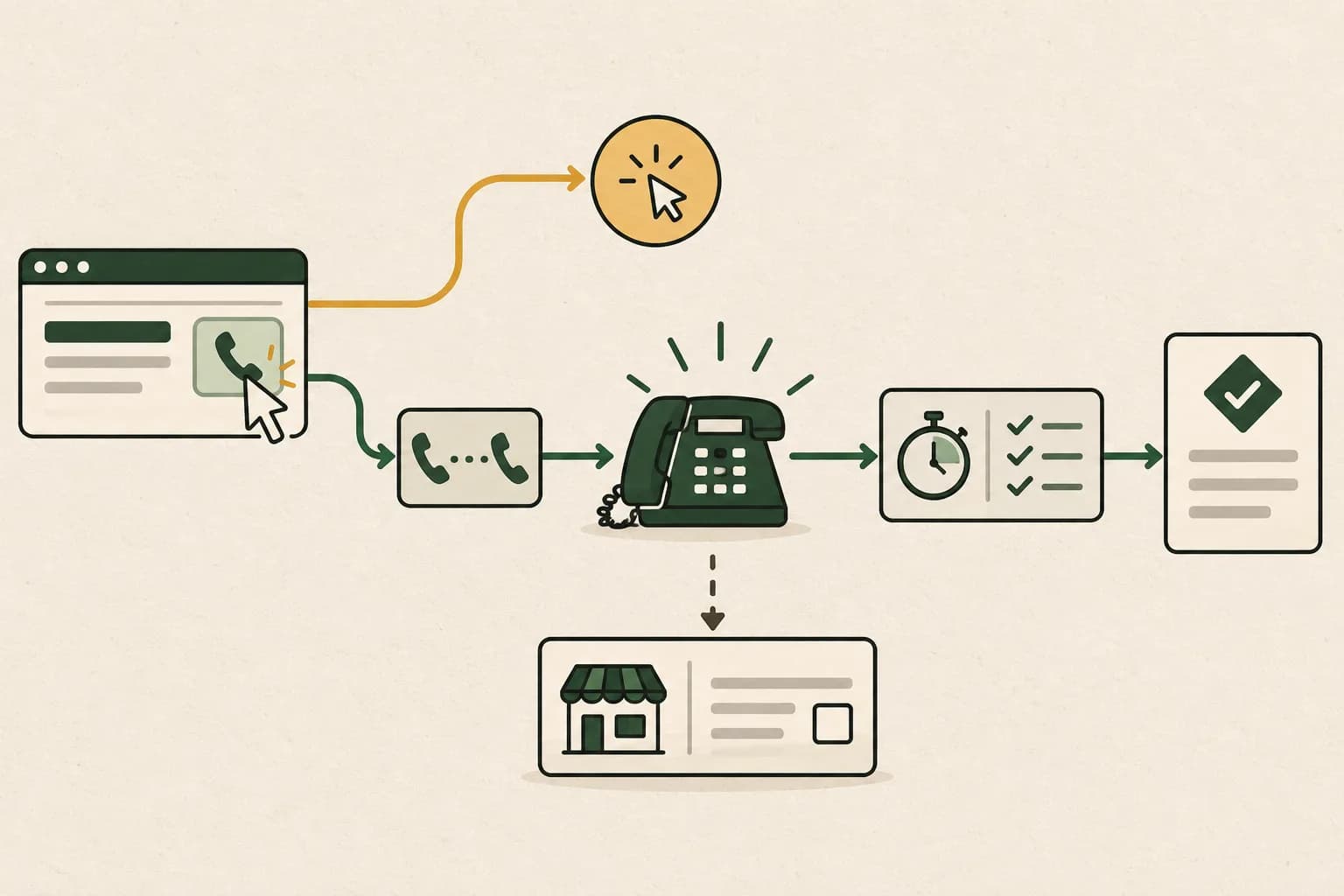
Start with three checks: identify the call-conversion source; establish whether the relevant tracking route actually exists; then compare the call record with that action's qualification and reporting rules. Changing every phone action to Primary will not repair a missing collection path.
This guide follows Google's current call-measurement documentation. It also distinguishes duration-based measurement from newer AI-qualified and estimated classifications, rather than assuming every call conversion uses the same timer.
Real questions that expose the problem#
In “Why is Google not recording my conversions?”, a business owner says customers call after finding the business on Google, the website is untagged, and call reporting is enabled. Those facts do not establish whether the calls came through an ad's forwarding number, the website's ordinary number, organic results or another route.
Another advertiser asks how to measure phone activity in a local-service campaign with an eligible call asset but no conversion tracking. An eligible asset and a functioning conversion action need separate verification.
An older real-phone-call measurement question describes both apparent conversions without received calls and calls without reported conversions. The advertiser reports that Google forwarding numbers are unavailable locally. A generic instruction to install forwarding-number tracking does not resolve that limitation.
These questions establish the diagnostic task; their replies are not evidence that a particular configuration or bidding change will work for your business.
Trace how the call reached your business
A phone tap, tracked call, qualified lead and booked job are distinct events. Discuss which call path your conversion setup measures.
Discuss measurement optionsA short inquiry to scope relevant options; no campaign access is needed.
Name the event before comparing the totals#
Google's phone-call measurement overview distinguishes several collection methods. Use the action's actual source, not its friendly name, to place it in this table:
| Measurement route | What you need to establish | What the observation does not prove |
|---|---|---|
| Calls directly from ads | Applicable call reporting, forwarding-number route and action rules | Every business call came from advertising |
| Calls after a website visit | Eligible tracking and actual replacement of the website number | Merely displaying an ordinary number measures calls |
| Mobile website phone-link clicks | The link-click event fired | A call connected or someone answered |
| Estimated calls from ad/asset interactions | The action uses that estimation method | A directly observed call record exists for each conversion |
| Imported call outcomes | The supported call-matching route and business outcome record | An upload receipt alone establishes attribution |
Keep your phone system's incoming, answered and missed calls separate from these platform measures. A customer saying “I found you on Google” is useful business information, but does not identify the paid-ad interaction or conversion action.
For general event and attribution boundaries, see the platform-versus-independent measurement guide.
Step 1: Inventory the phone actions and effective goals#
Save each action's identifier, owner, source, business definition, qualification settings, counting policy and applicable window. Include phone-link clicks and uploaded outcomes even if they have similar names to a recorded-call action.
Then inspect the specific campaign's goal selection. Google's primary/secondary reference explains that primary actions contribute to Conversions and bidding when their standard goal is selected. Secondary actions ordinarily support observation in All conversions; a selected custom goal is an exception and can include secondary actions in bidding.
Inspect both columns and the conversion-action segment before concluding an event is absent. Conversely, finding an event in All conversions does not prove it is the campaign's intended optimization outcome.
If ownership recently moved between client and manager accounts, use the cross-account tracking audit. A valid phone measurement configured under the wrong conversion authority requires a different investigation from an unresponsive website trigger.
Step 2: Trace calls made directly from an ad#
For the forwarding-number route, verify the business number, applicable country eligibility, account-level call-reporting setting and actual serving route. Google's call-reporting explanation describes calls being routed through a Google forwarding number to the business number.
An approved or eligible call asset is not proof it appeared on a particular impression. Save the relevant ad/asset context and date. Compare recorded calls with the phone system where a legitimate matching reference is available, rather than matching by rough daily totals alone.
Read the report fields: was the call received or missed, what duration was recorded, and which source does it represent? Keep the operational question—whether the business answered—separate from whether a configured conversion condition was met.
Google forwarding numbers can change or be reassigned. Do not copy one into permanent business listings, printed materials or unrelated campaigns as though it were your own durable number.
Step 3: Test website number replacement, not just a tag firing#
Website-call measurement has an additional collection boundary. Google's website-call instructions require an eligible setup and the ability to add tracking and number-replacement code. A phone number visibly printed on a page is not equivalent to this implementation.
Give the website owner a concrete acceptance checklist:
- The intended published page loads the correct conversion configuration.
- The configured business number matches the number the implementation is supposed to replace.
- The eligible visit reaches the correct landing page through its actual redirects.
- The visible number and the mobile link's
tel:destination both use the intended replacement when that route applies. - Other number-insertion tools are documented, so two implementations do not silently overwrite each other.
The visible text and the dialed destination deserve separate checks: Google's custom mobile example explicitly replaces both. A page can look correct while its link still calls another number.
Record device, page, implementation version, eligibility context and observed result. A website builder that cannot accept the required code is a concrete implementation blocker. Keep website click tracking accurately labeled if that is all the current installation can measure; do not describe it as confirmed calls.
Step 4: Inspect the qualification method actually in effect#
The current Measure calls from ads page describes recording-based AI qualification, duration fallback when recording is unavailable, and ad-interaction classification when duration or a forwarding number is unavailable. Google's dedicated AI-qualified call guidance describes the same tiered approach.
This matters when comparing a new report with an old duration-only definition. A long conversation is not automatically a booked job, and an AI-qualified call is not automatically a sale recorded in your CRM. Preserve the method's label with the result.
The recording eligibility reference limits availability: both the dialing and receiving phone numbers must be located in the United States or Canada, the call must use a Google forwarding number with call reporting enabled, and location-asset calls are not supported for recording. It also documents default-setting exceptions. Check the actual account and call source; these pages do not prove every advertiser has the same active configuration.
There is a documentation boundary worth preserving. The call-reporting analysis page still explains conversions primarily through duration, while the dedicated AI pages describe additional qualification. The reporting settings page broadly says disabling reporting stops Calls from ads tracking, whereas the measurement page describes interaction-based classification when duration is unavailable.
Do not resolve this by promising a universal fallback. Save the exact action type, recording/reporting settings, eligibility and report labels. Escalate an unexplained discrepancy with that evidence. This audit does not require changing recording settings.
Step 5: Reconcile dates and report levels#
Google's call-analysis reference explains that phone calls use the date the call occurred, while phone-call conversions can be reported against the ad-click date. A call after a month boundary may therefore appear in a different period from its attributed conversion.
Preserve the metric, date basis, timezone, conversion action, campaign scope and retrieval time. A phone-system call-time export cannot be compared casually with a click-date conversion total.
Also compare compatible reporting levels. Google documents that manually dialed calls to its forwarding number can appear at campaign/ad-group level without appearing in the keyword/ad breakdown. Missing detail at one level does not establish that the call vanished from every report.
Use two worksheets: one to reconcile call collection and another to reconcile qualified or attributed outcomes. They share references where supported, but they answer different questions.
A hypothetical example with explicit denominators#
Assume an approved QA dataset contains 20 distinct calls through one documented tracking route during a week, in one timezone. It includes 14 answered and six missed calls. Separately, the website records eight phone-link click events. There is no reliable join between those clicks and the calls.
For this example only, the selected action uses duration-based qualification, and nine of the 20 tracked calls meet its configured threshold. A business review later identifies four booked jobs among those nine.
| Measure | Hypothetical count | Population or denominator |
|---|---|---|
| Tracked incoming calls | 20 | Calls through the defined route |
| Answered calls | 14 | 14 of those 20 calls: 70% |
| Missed calls | 6 | 6 of those 20 calls: 30% |
| Duration-qualified calls | 9 | Nine meet this action's rule |
| Booked jobs in that qualified set | 4 | Four of those nine, not four of all leads |
| Website phone-link clicks | 8 | Separate events with no established join |
Do not add the eight clicks to the 20 calls and claim 28 enquiries. Do not call the nine duration-qualified calls nine booked jobs. And do not infer from this table that Google Ads must show nine conversions in a same-week click-date report: attribution, counting, windows and date basis still need checking.
If the qualification method changes to AI classification, retain that change as a break in definition. This duration-only example is not a prediction of the new classifier's result.
Step 6: Handle unsupported regions and imported outcomes honestly#
Check the relevant feature's eligibility, not just whether one call feature exists in the country. Google's call-import instructions have additional requirements and limitations: Google forwarding-number availability does not imply universal call-import support. The page specifically limits support in India and excludes Japan for that import route.
If a supported matching route exists, agree on the business outcome, matching evidence and import definition before building the report. Keep the call event and its later commercial outcome distinct. Use the offline-import diagnostic for processing and reporting checkpoints, while retaining the call-specific import requirements.
If no supported attribution route exists, a business call ledger is still useful. Record incoming/answered/missed calls and outcomes using the business's approved system; label customer-reported sources as self-reported. Do not invent a click identifier or present a guessed association as deterministic ad attribution. A possible third-party implementation needs its own availability and integration verification.
What a completed investigation should contain#
Keep a compact evidence packet: selected action IDs and owners; source and method; country/number eligibility; actual reporting and recording settings; website replacement checks where applicable; report definitions; and a limited private reconciliation using appropriate call references.
Close each gap with a named next step: website owner fixes replacement, account administrator confirms feature eligibility, operations reviews missed calls, or the reporting owner aligns clocks and populations. “Tracking is broken” is too broad to assign effectively.
The anonymized fashion-retail delivery-quality case illustrates a separate measurement boundary: verified delivery counts do not establish sales or conversion attribution.
For supported campaign-delivery evidence alongside your own call investigation, discuss a scoped review with AdProof. Bring campaign identifiers, dates, metric definitions and comparable exports. Phone-system records, Google call settings and call-outcome imports remain with their owning systems.
Frequently asked questions#
Does my untagged website explain every missing call conversion?
No. Website-call tracking needs its own implementation, but calls directly from ads follow a different route. Identify whether the caller used the ad's tracking number, the website number or another source before assigning the cause.
Does a click on a phone button confirm a connected call?
No. Mobile website phone-link measurement records the click. It does not establish connection, answering, qualification or a completed business outcome.
Should every call above my duration threshold count as a conversion?
Only interpret that expectation within an applicable duration-based action and its other rules. Current Google documentation also describes recording-based AI qualification and interaction-based classification. Confirm the active method rather than assuming all actions use duration alone.
Can I import call outcomes wherever Google forwarding numbers exist?
No. The call-import feature has separate eligibility and matching requirements. Verify the current supported route and retain unmatched outcomes separately rather than guessing attribution.
Trace how the call reached your business
A phone tap, tracked call, qualified lead and booked job are distinct events. Discuss which call path your conversion setup measures.
Discuss measurement optionsA short inquiry to scope relevant options; no campaign access is needed.