
- Published
- Nov 5, 2026
- Reading time
- 11 min read
Shopify Attribution Double Counting: Audit Orders Across Models
Avoid counting a Shopify order twice when combining last-click and last non-direct reports. Audit model overlap, channel dimensions and a single order ledger.
In this guide (10 sections)
An order shown as Direct under last click can already be included in a last non-direct report under another channel. Checking that it is absent from a last-click Google row does not prove it is absent from your last non-direct total. Compare order membership under the same model and report contract before adding anything. Keep one business-order ledger and label each attribution view separately.
A public Shopify attribution question describes adding selected Direct orders from a last-click report to a total assembled under last non-direct click. The author asks whether checking a different Google filter prevents duplication. The original displayed an eight-hour age label when retrieved on 5 November 2026; it did not expose an exact creation timestamp. One substantive reply was visible. That establishes a real reporting question, not a measured trend or a verified account result.
This guide addresses that manual model-combination task. For a missing purchase event, an amount mapping error or Meta campaign credit, start with Meta purchases versus Shopify orders. For configured Google Ads value adjustments, use the conversion-value audit. Those investigations should not be collapsed into one explanation for every sales discrepancy.
Why a last-click exclusion does not establish uniqueness#
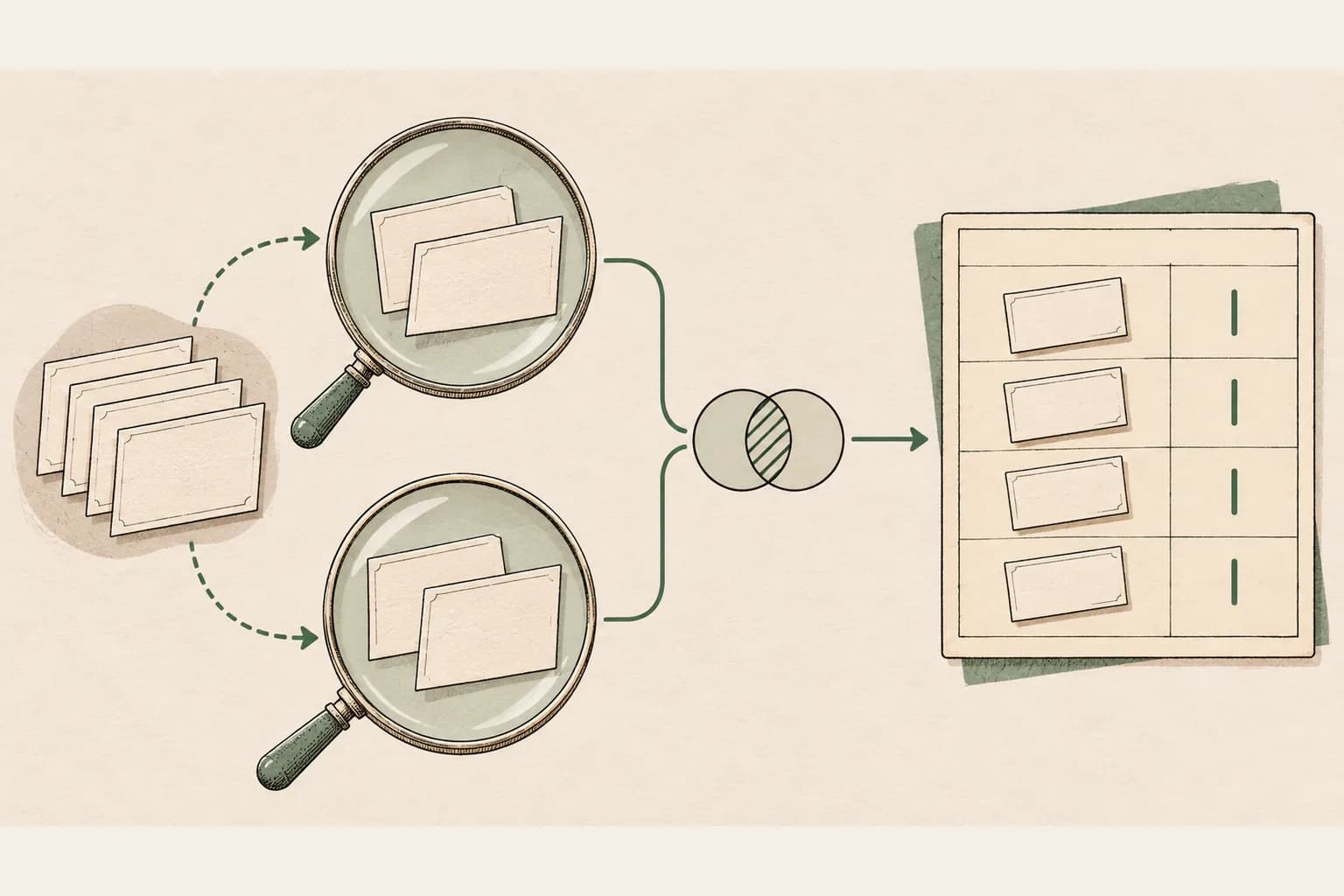
Think of the business order as the object and the report model as a lens. Changing lenses can change the row that receives credit. It does not necessarily create a separate set of business objects.
For a hypothetical journey, a shopper arrives from a paid Google visit and later returns directly to purchase. Assume both visits are observable and eligible under the selected report rules. Last click can place the order under Direct. Last non-direct can place it under the prior non-direct channel. If your first total already includes that channel, manually adding the Direct order counts the same order again.
Shopify's marketing-report reference distinguishes last click, which includes direct visits, from last non-direct click, which skips direct visits unless the journey is entirely direct. It also warns that Any click can allocate more credit than the number of orders. These are allocation rules, not additional order creation.
An order absent from one last-click Google subset may still belong to a last-non-direct Google subset. The comparison used to exclude it is therefore insufficient. Establish membership in the actual set you intend to extend; do not substitute a similarly named subset from another model.
Keep order receipts separate from ad credit.
Use the related reconciliation guide to distinguish purchase records, value mapping and campaign attribution.
Read the order reconciliation guideOpens a practical guide. No email required.
1. Freeze the comparison before opening individual orders#
Save the current report configuration before editing it. Record the reporting interval, timezone, extraction time, model, dimensions, filters, metric and sales-channel scope. Keep the original exports and your proposed adjustment in separate files.
Write a one-sentence purpose: for example, “Count eligible paid online-store orders in this interval once, then show how two attribution models allocate that cohort.” This is more testable than “find the real Google revenue.” The latter mixes a business total, an allocation policy and a causal claim.
| Contract field | Record explicitly | Error it helps expose |
|---|---|---|
| Business object | Order, paid order, session or attributed credit | Comparing unlike units |
| Amount | Named sales metric and currency | Treating different monetary definitions as interchangeable |
| Date basis | Order date or the report's documented basis | Joining different cohorts |
| Allocation | Exact selected model | Adding overlapping model results |
| Dimension | Marketing channel, platform or referring channel | Confusing a paid product with a referring site |
| State | Included payment, cancellation and refund treatment | Counting a later business state as an original result |
These are recommended audit fields, not a promise that every Shopify screen exposes all of them. Missing fields are evidence limitations to document. They are not permission to guess a default or copy a neighboring report's settings.
2. Keep paid credit separate from a broad Google grouping#
A row grouped around Google can mean different things depending on the dimension. It can describe paid marketing, organic discovery or a referring property. A visible Google touch does not by itself establish a paid advertising interaction.
Shopify's marketing documentation distinguishes Marketing channel, Marketing platform and Referring channel. Use their actual selected definitions rather than treating those labels as synonyms. Its documentation also identifies an 18 October 2026 referring-classification change; totals are not changed by that reclassification. A row-label shift across that date needs its own check.
Before combining rows, state the meaning of the combined figure. A total containing paid, organic and unknown allocations is not automatically paid Google Ads revenue. Unknown is an uncertainty category, not an unclaimed pool that can be assigned to whichever advertiser appears most influential.
It can be useful to retain a broad platform grouping as a separate descriptive view. Label it clearly, list the included rows, and preserve the paid-only comparison alongside it. Do not silently change the definition of a client's paid-return metric halfway through the report.
3. Build one order ledger, then attach observations#
Use an authorized order export or internal commerce record as the starting point for unique business orders. Retain a stable internal order identifier within the merchant's private workspace. Do not send customer details, full journeys or order identifiers into public troubleshooting posts.
Create one record per order in your chosen cohort. Attach the amount definition and relevant state to that record. Store each report observation as a separate column or related table with its model and extraction time.
For a small diagnostic sample, a worksheet can contain:
- A private order reference and the agreed eligible-order flag.
- The business amount in one currency under the chosen definition.
- Last-click allocation, if directly established.
- Last-non-direct allocation, if directly established.
- Whether that order is already included in the proposed starting total.
- Evidence status: established, contradictory or unavailable.
Do not assume an aggregate marketing export contains order-level membership. Shopify documents report export options, but availability of an export does not guarantee that every desired dimension or identity join exists. Inspect the actual columns and row grain. Several product or adjustment rows can belong to one order.
Where you cannot establish membership, mark it unresolved. You can still publish the business-order total and separately labeled model aggregates. You cannot responsibly produce a verified union by treating every unknown overlap as zero.
4. Test membership against the right starting set#
Let A be the set of order references already represented in the starting attribution total. Let B be the candidate Direct-order set you propose to add. If both are genuinely comparable order sets, the unique combined count is:
unique combined orders = orders in A + orders in B − orders in both
That is set arithmetic for an audit worksheet, not a Shopify query or a guarantee about report exports. The overlap must concern A itself, under its recorded model and scope. Absence from a different last-click Google report is not the required test.
For amounts, attach each eligible order's agreed business amount once to the union. Do not add two report values just because their order references match: the reports may use different sales definitions or extraction dates. Reconcile those definitions first.
With fractional allocation models, attributed credit is not a simple membership count. Preserve the credit weights and denominators separately from the ledger of whole orders. A unique order count and a sum of channel credits can both be useful without being numerically interchangeable.
A hypothetical six-order audit#
The following is invented solely to demonstrate the worksheet. Assume six eligible orders, each worth USD 100 under one fixed amount definition, with no refunds, currency changes or incomplete observations. Letters are conceptual references, not customer identifiers.
| Order | Last-click view | Last-non-direct view | Already in starting Google grouping? |
|---|---|---|---|
| A | Google paid | Google paid | Yes |
| B | Direct | Google paid | Yes |
| C | Direct | Google organic | Yes |
| D | Direct | Direct-only journey | No |
| E | No | ||
| F | Unknown | Unknown | Yes, because this example's starting grouping includes Unknown |
The starting grouping contains A, B, C and F: four orders and USD 400. The proposed Direct additions contain B, C and D: three orders and USD 300. Their overlap contains B and C: two orders and USD 200.
Adding the headline totals produces seven orders and USD 700. The unique union contains five orders and USD 500: 4 + 3 − 2 = 5. The entire business cohort still contains six orders and USD 600, because E was outside both selected sets.
Even the corrected five-order union is not proved paid Google Ads revenue. It includes organic, unknown and a direct-only journey by construction. Deduplicating an unjustified attribution grouping repairs its arithmetic; it does not validate the grouping's business meaning or prove advertising incrementality.
5. Use conversion summaries as evidence, not a reassignment rule#
For selected orders, inspect the available conversion summary and journey details. Shopify's conversion-summary reference describes full, limited and unavailable summaries. A missing timeline can reflect unavailable tracking; it does not establish an all-direct journey. Details may also take time to appear.
Record the observations visible at a stated extraction time. A prior Google visit can support a hypothesis about an order's path. It does not establish the paid-versus-organic classification, every eligibility condition or membership in a different aggregate report.
If a model allocation contradicts the visible journey, preserve both. Ask the report owner which model, dimension and cohort the allocation uses. Changing the final spreadsheet assignment to match your intuition hides the contradiction instead of resolving it.
6. Separate reporting repair from causal evaluation#
Sales falling when ads pause is a reason to investigate contribution, not a license to allocate all ambiguous sales to that channel. Timing, demand, promotions and other changes can move together. A model-combination worksheet does not control those explanations.
Keep three outputs separate: the unique business-order ledger, the platform's labeled credit report, and any experimental estimate of incremental impact. If you need an experiment, define its outcome, comparison population and uncertainty before interpreting a change. The geo-holdout diagnostic explains why a noisy comparison needs power and uncertainty checks.
Shopify's sales-report definitions are also important when selecting an outcome: sales measures and payment receipts answer different questions, and later adjustments can change the comparison. A larger attributed amount need not mean more cash collected.
A practical closeout checklist#
Before sending the revised report, confirm that every included order belongs to the same defined cohort; each business amount appears once; model, dimension and filters remain attached to every attribution figure; unresolved membership remains visible; and paid-only reporting is distinguished from broader platform involvement.
Keep the rejected calculation in the private change log with the reason for rejecting it. Explain whether the correction changed order uniqueness, monetary definitions or allocation policy. That makes a future reporting revision auditable without implying that tracking was repaired.
If a separate question concerns whether advertising was delivered as agreed, discuss the campaign and supported measurement scope with AdProof. Bring dates, counting definitions and the relevant delivery exports alongside this commerce audit. Confirm supported coverage; a delivery review does not turn incomplete Shopify journeys into a complete order-attribution join. The fashion retail measurement case shows why delivery evidence deserves its own scope.
Frequently asked questions#
Does a Direct order always become Google under last non-direct click?
No. It depends on the eligible observed journey. An all-direct journey can remain Direct, and a prior non-direct source may be a different channel. Do not assign a missing journey to Google by assumption.
Can I add last-click and last-non-direct totals after removing duplicate order references?
Only when you can establish comparable membership and a deliberate reason for the union. Deduplication fixes overlapping objects, but does not make that union a valid paid-revenue or causal-contribution metric.
What if the marketing export has no order-level identifiers?
Keep aggregate model views separate and use an authorized business-order ledger for unique totals. Inspect available order summaries for a bounded sample. Mark the overlap unknown rather than inventing a complete join.
Is higher Shopify revenue evidence that Google Ads is missing conversions?
Not by itself. Compare units, eligible orders, dates, amounts and allocation rules. Investigate event collection only when the evidence establishes a collection question, rather than forcing campaign credit to equal all store sales.
Keep order receipts separate from ad credit.
Use the related reconciliation guide to distinguish purchase records, value mapping and campaign attribution.
Read the order reconciliation guideOpens a practical guide. No email required.