
- Published
- Nov 5, 2026
- Reading time
- 10 min read
Mixed VAST Versions: Validate the Response You Assemble
Combining VAST ads from different versions? Choose an output contract, preserve tracking obligations, then validate the complete response and player behavior.
In this guide (8 sections)
Declare a VAST version that the complete response you produce actually satisfies. Do not choose the largest input version and assume that copying its neighboring ads completes the conversion. First establish the receiving integration's accepted output contract. Then inspect every retained ad, validate the assembled document against the corresponding schema and test the required playback and measurement behavior separately.
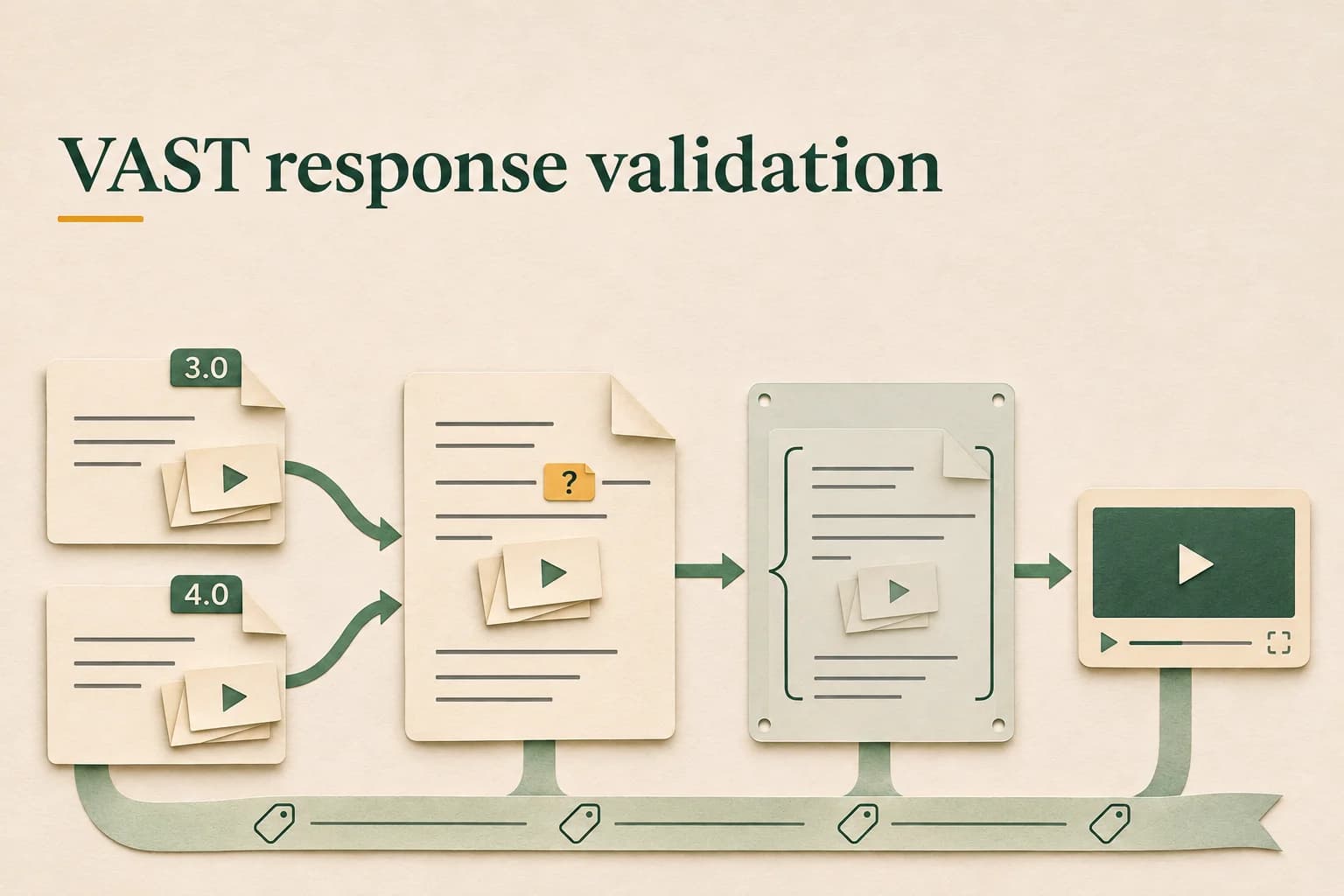
An older Stack Overflow question about combining VAST responses makes the problem concrete: one response is labeled 4.0, another 3.0, and the author wants both Ad children inside a new root. The question was posted in August 2022; its July 2023 answer suggests considering the features used and selecting the highest version. That is historical implementation advice, not evidence that the proposed output is compliant or accepted by a particular player.
This guide provides an acceptance workflow for an operator or engineer assembling responses. It does not prescribe a universal merger, supply a complete playable tag or claim a tested fix for the original question.
Treat the new response as a new contract#
The version declaration belongs to the output document. IAB Tech Lab's versioned VAST 4.3 reference, sections 3.1–3.2, associates that declaration with the response's claimed compliance. Section 2.3.2 separately requires a well-formed document and a schema check. These are reasons to inspect the result, rather than infer validity from two source labels.
Start by writing down exactly what is being created. Appending two ad nodes, resolving a wrapper, composing a pod and forwarding an unchanged response are different operations. A developer saying “we merge VAST” has not yet identified which of them occurs.
Keep this handoff record with an authorized test:
| Record | What to preserve |
|---|---|
| Inputs | Exact retrieved documents, retrieval times and the request contexts that produced them |
| Operation | Which nodes are copied, transformed, omitted or newly generated |
| Output | Exact final document and the assembly implementation's release identifier |
| Receiver | Actual player, SDK or insertion service and its applicable configuration |
| Acceptance | Agreed format, supported features and observable success conditions |
Use sanitized fixtures when sharing this record. A URL or identifier can contain campaign information; the investigation does not require publishing live credentials, customer names or private targeting values.
Preserve each reporting obligation after assembly.
Audit wrapper and inline recipients separately once the response contract is defined.
Audit VAST tracking recipientsOpens a practical guide. No email required.
Choose the receiving contract before transforming the inputs#
Obtain the receiver's documented requirements and the relevant implementation owner's confirmation. Distinguish an accepted response version from support for every feature expressible in that version. IAB's migration guidance describes backward compatibility with limitations; it does not make newer functionality available in every older player. It also says an ad server should honor a player's explicit lower-version request.
That means “use 4.0” is incomplete when the actual handoff requires 3.0. Conversely, declaring 3.0 is not a safe way to disguise retained features whose required representation belongs to a different contract. Record the incompatibility and choose a supported arrangement with the receiving team.
A practical output-contract sheet should name the target version, any agreed addendum, supported ad types and the required measurement features. It should also say what happens when an input cannot be represented under that agreement. Possible decisions include rejecting that input or obtaining a compatible alternative; they should not be silent runtime guesses.
Check the official VAST resource page and schema repository for the materials relevant to the agreed target. The resource page also points to addenda affecting earlier versions. A repository filename or the newest visible file is not, by itself, proof of the receiver's contract. Save the exact selected artifact or revision with your test.
Inventory features and obligations at each ad boundary#
For each retained ad, identify what the assembly code must carry forward and what must change. Make this inventory from the delivered inputs, not from the campaign's expected creative template.
The following is an investigation worksheet, not an exhaustive VAST conformance checklist:
| Boundary | Review question |
|---|---|
| Structure | Is the ad represented as inline material or a reference to another response? |
| Target representation | Which required elements, attributes or ordering need checking under the chosen schema? |
| Media | Are the retained assets and declarations suitable for the receiving path? |
| Identity | Can each output ad be traced back to the authorized input and transformation? |
| Measurement | Which impression, playback, error, click or verification obligations apply? |
| Sequence | Does the output's intended ordering agree with the agreed playback arrangement? |
Do not manufacture a missing business identifier merely to remove a validator error. Find the responsible serving party, establish the correct value or retain a hold. Keep creative identity, an ad-serving occurrence and a campaign identifier separate in the evidence record.
The VAST trafficking guide owns publisher acceptance, assets and serving arrangements. Use it alongside this worksheet when the output will enter a CTV workflow. Choosing an XML version cannot settle creative approval, rendition availability or integration support.
Preserve measurement obligations without multiplying exposures#
Assembly can change the evidence path even when the selected media still plays. An input's reporting destinations should therefore be part of the transformation review. Establish which destinations remain applicable to each output ad, where they originated and which component owns dispatch.
A wrapper and an inline response have different roles. IAB's reference describes the wrapper as pointing onward, while inline material supplies the playable creative. Flattening that relationship is an implementation change that needs a documented obligation map; copying the media alone is not a complete measurement acceptance test.
Use the multiple VAST tracking recipients audit for event-specific recipient behavior. That guide separates one event reaching several intended recipients from duplicate dispatch to the same obligation. Do not turn a count of tracking URLs into a count of impressions, people or completed ads.
For the assembly test, keep one row per output ad, event and applicable recipient. Trace that row through the input, transformed output, dispatch owner and receiver evidence. If a recipient is deliberately removed, require an explicit reason and acceptance by the responsible parties. Do not quietly remove inconvenient tracking elements to make a small fixture pass.
Run separate format and behavior checks#
A useful result distinguishes at least three gates:
- Parsing: the actual output can be read as the intended XML document.
- Schema: the whole output satisfies the chosen schema, including the representation of every retained ad.
- Integration behavior: the intended receiver accepts the response and performs the agreed playback and measurement behavior.
Passing one gate does not establish the others. A successful request for the VAST URL is also a different observation: it does not prove that the returned body is the expected document or that a player executed it.
Keep the validator name, version, schema artifact and full diagnostic output. The official repository's testing note names a particular .NET code-generation check and says JAXB was not verified. That limited note should not be represented as certification of your validator, transformation or player.
For receiver tests, use authorized fixtures and the actual supported integration. Observe each relevant ad rather than relying only on a manager-level completion message. Confirm the selected media, playback ordering, required event occurrence, dispatch attempts and available receiver acknowledgements. Leave unavailable evidence labeled unknown.
Where a trace reaches wrapper resolution or media loading and fails, follow the VAST error investigation. Raising a timeout does not repair a document that fails the agreed format contract. Where substitution or URI encoding changes, use the macro-boundary diagnostic rather than treating all malformed URLs as a version mismatch.
Work through a two-input acceptance example#
Hypothetical example only: an assembly service receives one response labeled 4.0 and one labeled 3.0. It intends to produce one document containing two ads for an integration with an agreed 4.0 output contract. No actual validator, player or vendor result is asserted here.
| Fixture | Proposed observation | Decision |
|---|---|---|
| First input alone, under its declared contract | Keep its saved validation and receiver results | Establish an input baseline, not a combined-output pass |
| Second input alone, under its declared contract | Keep its separate results | Preserve the original representation before conversion |
| Both copied under a 4.0 root | Inspect all diagnostics against the target schema | Hold if any retained ad fails the output contract |
| Corrected representation under the same target | Re-run the complete validation, not only the previously failing element | A format pass allows the next gate; it is not playback proof |
| The validated output at the agreed receiver | Observe the two intended ad paths and applicable reporting obligations | Accept only the supported behaviors established by this test |
The important artifact is the transformation record: which specific property failed, how the responsible owner corrected it and what the subsequent test established. “Changed the root to 4.0” is not enough to explain that record.
Two ads in an assembled document are not automatically two delivered impressions. A receiver may not execute every candidate; failures and unsupported arrangements need their own observations. Likewise, several reporting destinations for one executed ad do not create additional exposures.
Add negative fixtures for a missing target-required field, an unsupported feature, an intentionally incompatible receiver contract and a changed URI boundary. Record the expected hold for each case before running it. A test suite that accepts every input cannot demonstrate that the assembly enforces the agreement.
Close the handoff with a bounded result#
An acceptance note should identify the assembler release, output schema, receiver build, fixture set and results. Include the original and transformed documents, the obligation map and unresolved limitations. Say which tested arrangement works and which inputs remain excluded.
Re-run the relevant fixtures when the assembly implementation, target agreement, schema artifact, SDK or delivery arrangement changes. Keep earlier receipts so a later successful test is not mistaken for evidence about historical delivery. Do not rewrite old campaign totals merely because the new output passes validation.
For campaigns already measured in AdProof, retain the available campaign-event or aggregate evidence with matching scope beside the independently obtained assembly and player traces. The anonymized streaming publisher study illustrates keeping a delivery scope explicit; it does not establish XML-validator or merger capabilities. Discuss the evidence available for your campaign before assuming that a new integration or event path is independently covered.
Frequently asked questions#
If the inputs are VAST 4.0 and 3.0, should the output always be 4.0?
No automatic answer follows from those labels. Establish the receiver's accepted contract, then validate the complete proposed representation against that target and test the required behavior. Retaining a higher-version feature does not make a differently structured ad conform merely by changing the root label.
Can choosing the highest version replace a schema check?
No. Version selection and document validity are separate checks. Keep a feature and obligation inventory, the exact target artifact and full validation results for the output that will actually be served.
Does a schema pass prove that every tracker will fire?
No. It establishes a format result for the tested document and schema. Dispatch ownership, supported runtime behavior, transport and receiver processing need separate evidence.
Is combining ads the same as flattening a wrapper chain?
No. Record the actual transformation. A wrapper references another response, whereas appending ads creates a different output arrangement. Either change needs its own identity, reporting-obligation and receiver acceptance review.
Preserve each reporting obligation after assembly.
Audit wrapper and inline recipients separately once the response contract is defined.
Audit VAST tracking recipientsOpens a practical guide. No email required.