
- Published
- Oct 30, 2026
- Reading time
- 11 min read
CTV Impressions With the TV Off: Audit Signals and Inactivity
Investigate CTV events that continue after a screen-state change. Separate confirmed TV-off evidence, inactivity rules, missing signals and report exclusions.
In this guide (10 sections)
Continuing CTV requests do not prove that a television is displaying an ad. They also do not, by themselves, prove fraud. Identify which component kept running, whether the integration actually observed the display state, and how the measurement service treated those events.
Keep four findings separate: confirmed TV-off activity, activity excluded by an inactivity rule, signals that disagree, and unavailable screen-state evidence. Then reconcile the exclusions without subtracting the same event twice.
An archived ad-operations question about impressions while the TV is off asks what the MRC's guidance means for measurement. Its replies disagree about how often a separately powered device might continue serving. Those opinions do not establish a current incidence rate. The useful operational question remains: what can your integration observe, and what does the final impression total exclude?
Start with the device, display and event path#
A television, streaming device, player and measurement recipient are different components. A streaming device may have power independently of the display. An app can also change visibility while the television stays on. Draw the actual path rather than treating every component as “the TV.”
Write down who produces the relevant request or event: a player, SDK, insertion service or measurement endpoint. Identify its trigger and timestamp. A request for future media, a reported playback event and a received tracking callback are different observations.
For an SSAI path, keep the insertion service and client player on the same diagram. Ask what evidence reaches the stitcher and what it forwards to measurement. The SSAI verification guide explains why server activity and client evidence need separate owners.
First confirm that the inventory is within the intended TV-device scope. A broad streaming campaign can include other devices; use the CTV-versus-OTT device audit when that classification is disputed.
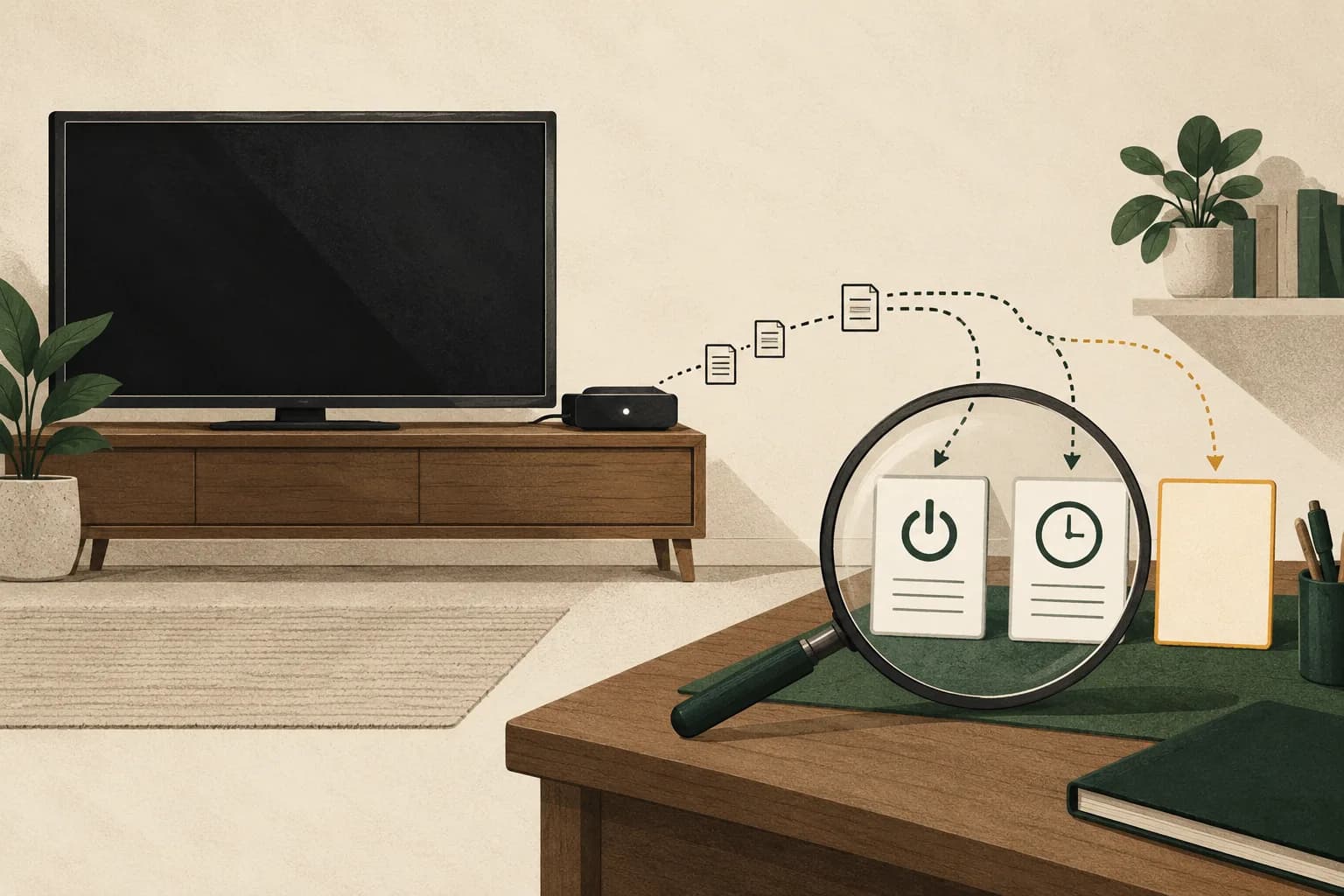
Put inactive-screen signals in context.
Separate continued requests from observations of the television display.
Discuss video measurementA short inquiry to scope relevant options; no campaign access is needed.
Distinguish a state observation from an inactivity inference#
| Finding | Evidence required | Limit on the conclusion |
|---|---|---|
| Display confirmed off | A supported state signal tied to the relevant interval and delivery path | Does not establish every other event's state |
| App not visible or backgrounded | Supported app lifecycle or visibility observations | Does not necessarily describe the external display's power |
| Inactivity rule triggered | The service's session, timer and reset definitions | Is not direct observation that someone left or switched off the TV |
| Continuing network or event activity | Sender, trigger and timestamp | Is not proof of visible playback or an attentive viewer |
| State unavailable or conflicting | Coverage and diagnostic record | Must remain unresolved under the stated review method |
The MRC's August 2021 SSAI and OTT guidance, section 2, says events confirmed to occur with the TV off should not be counted as ad impressions, although they may be reported separately. It separately treats inactivity exclusion as data editing rather than filtered invalid traffic. This is dated measurement guidance, not evidence that every current device exposes a power-state signal or that a named service has implemented the same policy.
An overnight impression, a long session or the absence of a remote-control interaction cannot independently settle the display-state question. Conversely, missing state information should not be silently converted into proof that the screen was on.
Step 1: request the signal's origin and coverage#
Ask the measurement provider which state signals it receives for the affected app, device and integration version. Record whether a value is directly observed, publisher-provided, inferred or unavailable. Preserve the time of the observation and its association with the ad event.
A generic statement that an SDK supports CTV is insufficient. The IAB Tech Lab CTV programmatic guide describes Open Measurement's role in collecting CTV signals such as screen state and interaction context in supported environments. Availability of that framework does not establish deployment or signal coverage on every placement.
Platform documentation can narrow the question. Google's Display & Video 360 methodology describes visibility notifications for devices certified to carry YouTube and power-state signals on Android TV and tvOS where possible. That is a scoped implementation statement. Do not apply it automatically to another player, every app on the same operating system or a separately configured measurement recipient.
Request a coverage matrix containing the app/player path, relevant versions, supported state, source, receiver interpretation, last validation and missing-data behavior. A useful review can conclude that one path has unavailable evidence without pretending the whole campaign has been validated.
Step 2: obtain the actual inactivity rule#
Ask for the exact definition of a session, its inactivity condition, reset events, timezone and reporting treatment. Determine whether a request, an interaction or an observed player action resets the timer. Those are not interchangeable.
For a specific current example, Campaign Manager 360's methodology describes its Inactive Impressions metric using more than 16 hours of continuous ad or bid requests without a reset. It documents daily resets at 5:00 AM local time, a gap longer than 30 minutes without a request, and VAST interaction pings such as pause or volume changes. Its inactivity measurement is scoped to CTV.
That is a description of one service's metric, not a recommended timeout for your app or a universal rule defining whether a person is watching. Do not replace it with a shorter threshold simply to make an investigation produce more exclusions.
Check the effective method used for your reporting period. Save the definition and any relevant version or policy change with the export. A longer observed session can have a legitimate explanation; the question is whether the declared method was applied consistently to its supported population.
Step 3: test state transitions on an authorized path#
Use a small controlled test with a known device, app and player version. Record the physical action and the timestamps independently of the measurement stream. Then inspect what each component reports.
| Controlled condition | Compare | Useful acceptance question |
|---|---|---|
| Ordinary foreground playback | Player events and receiver records | Does the supported baseline produce the expected evidence? |
| Pause or mute interaction | Actual action and observed reset/event | Does the service interpret the declared interaction correctly? |
| App backgrounds or loses display visibility | App state, playback and measurement | Which events stop, continue or become unavailable? |
| Display powered off while another component remains powered | Available state evidence and subsequent events | Can this integration establish the display state? |
| Playback resumes | Session/event identifiers and resulting counts | Does the same ad resume without accidental duplicate counting? |
Do not assume that a sleep event from one component describes every component. The Android Open Measurement FAQ explains Android backgrounding behavior and maintaining the same session when interrupted playback resumes. Check the applicable integration rather than copying that lifecycle into unrelated TV platforms.
Preserve request timing, reported state and the receiver's accepted record. A missing signal may reflect unsupported capability, transport or implementation; locate the boundary before changing the policy. Do not generate artificial interactions or callbacks to keep a session “active” or make the test pass.
One successful test supports that tested path. It does not retrospectively establish the screen state of all historical events, authenticate every device or demonstrate viewer attention.
Step 4: reconcile candidate events and exclusions#
Start with a defined population after an agreed duplicate-handling step. Request the count removed for confirmed state, the count removed by inactivity rules, their overlap and the remaining unexplained population. Keep IVT filtration separate unless the provider explicitly documents a relationship.
Google's reporting calculation reference illustrates why exact metric names matter: its gross begin-to-render calculation excluding inactivity adds the corresponding impression and invalid-impression measures, then subtracts inactive impressions. Use that formula only for its documented metrics and compatible scope. It is not permission to subtract any column labeled inactive from any other provider's total.
Hypothetical example: do not subtract the overlap twice
Suppose a hypothetical audit starts with 10,000 distinct candidate impression events. Under its stated review policy, events with confirmed TV-off evidence or a triggered inactivity rule are excluded. There are no other adjustments in this teaching example.
| Mutually exclusive review category | Candidate events |
|---|---|
| Confirmed TV-off only | 400 |
| Inactivity exclusion only | 200 |
| Both findings | 100 |
| Neither finding established | 9,300 |
| Total | 10,000 |
Confirmed TV-off findings cover 500 events; inactivity findings cover 300. Their combined exclusion is 500 + 300 − 100 = 700 events, or 7% of the candidate population. The remaining count under these two rules is 9,300.
Subtracting 500 and 300 without the overlap adjustment would remove 800 and produce an incorrect 9,200 remainder. Alternatively, use the mutually exclusive rows and subtract 400 + 200 + 100 once.
The 9,300 remainder means neither of these two findings was established. It does not mean all 9,300 were viewable, attentive or valid under every other quality test. If state was unavailable for some records, disclose that coverage separately rather than renaming the entire remainder “screen on.”
These are invented diagnostic figures, not customer results, a rate of TV-off activity or a measure of recoverable spend.
Step 5: choose a repair that matches the failure#
If an available state signal disappears between the player and receiver, investigate that handoff. If an integration reports the wrong lifecycle, fix the specific implementation with its owner. If a metric uses a documented inactivity rule, reconcile its inputs and output before asserting the rule failed.
When a path cannot expose the needed state, document the limitation and agree how the buyer will evaluate that inventory. Do not fill the missing field with a guessed value or promise a platform-wide remedy based on one app release.
Use a bounded change request: affected path, sample events, missing or conflicting observation, expected behavior and acceptance test. Repeat the same controlled sequence after the candidate fix. Then compare a completed production interval with the same scope and rules.
A reduction in unexplained events can be reported as improved evidence coverage. A change in exclusions can be reported under the stated method. Neither alone establishes saved media spend, improved advertising effectiveness or a causal change in sales.
What to request from the next measurement review#
Bring a short evidence packet with:
- Campaign scope, event definition, reporting dates, timezone and extraction time.
- App, device, player and measurement integration versions.
- State-signal origin, availability, timestamp and receiver interpretation.
- Inactivity method, reset conditions and effective reporting treatment.
- Controlled-test observations and corresponding receiver records.
- Candidate count, exclusions, overlap and unresolved coverage.
- Named owner, proposed correction and repeatable acceptance test.
The broader CTV measurement guide helps assess the provider's measurement contract. Use the viewability reconciliation guide for supported pixel/time results and eligibility populations. A TV-off or inactivity investigation should not silently redefine those metrics.
Frequently asked questions#
Can a streaming device continue making requests when the TV is off?
A separately powered component can continue operating, but determine what happened on the actual path. Continuing requests do not prove visible ad playback or establish that every such request became a counted impression.
Are inactive impressions automatically invalid traffic?
No. Keep the service's inactivity editing separate from its IVT classification. Document the rule and report treatment, and check overlap before combining exclusions. The cited MRC guidance explicitly distinguishes the two operations.
Does no remote-control interaction prove nobody watched?
No. A long interval without interaction can be an input to an inactivity method, not direct proof that the display was off or the viewer absent. Use the declared method and retain unavailable or conflicting state evidence.
Does a successful OM SDK integration prove every TV-off event is detected?
No. Confirm the exact app/device path, signals supplied, supported versions and receiver behavior. Integration availability and a test on one path do not establish universal coverage or viewer attention.
Connect event evidence to the campaign review#
For campaigns sending relevant events to AdProof, prepare a campaign-scoped export with matching dates, timezone and supported inventory filters. Compare the available event record with separately obtained player, publisher and measurement-service evidence. Confirm which state-related fields exist in the actual integration before making a screen-state conclusion.
The anonymized streaming-publisher verification case provides delivery-reconciliation context. It does not establish a TV-power sensor or attention-measurement capability. Request an AdProof measurement review with the event population and the state or inactivity discrepancy you need to resolve.
Put inactive-screen signals in context.
Separate continued requests from observations of the television display.
Discuss video measurementA short inquiry to scope relevant options; no campaign access is needed.