
- Published
- Oct 25, 2026
- Updated
- Oct 29, 2026
- Reading time
- 16 min read
Pre-Bid Passed, Post-Bid Blocked: How to Investigate Verification Reports
Ads pass pre-bid checks but get blocked after purchase? Investigate policy mismatches, unknown URLs, geo rules, and reporting with an evidence checklist.
In this guide (13 sections)
You enabled pre-bid protection, launched the campaign, and still see post-bid blocks. One report says an impression failed for geography. Another says it was blocked because the page URL was invisible. Neither label tells you, by itself, what the user saw or which campaign control needs fixing.
The useful investigation compares the actual decision stages, effective policies, inventory coverage, and evidence behind each result. This guide gives you a workflow for doing that without removing a protection simply to improve delivery.
The reader problem appears in a programmatic discussion about post-bid blocks despite pre-bid controls and an ad-operations question about failed versus blocked IAS metrics. These discussions establish the questions people ask. Vendor definitions, integration evidence, and current documentation must establish the answers for a specific campaign.
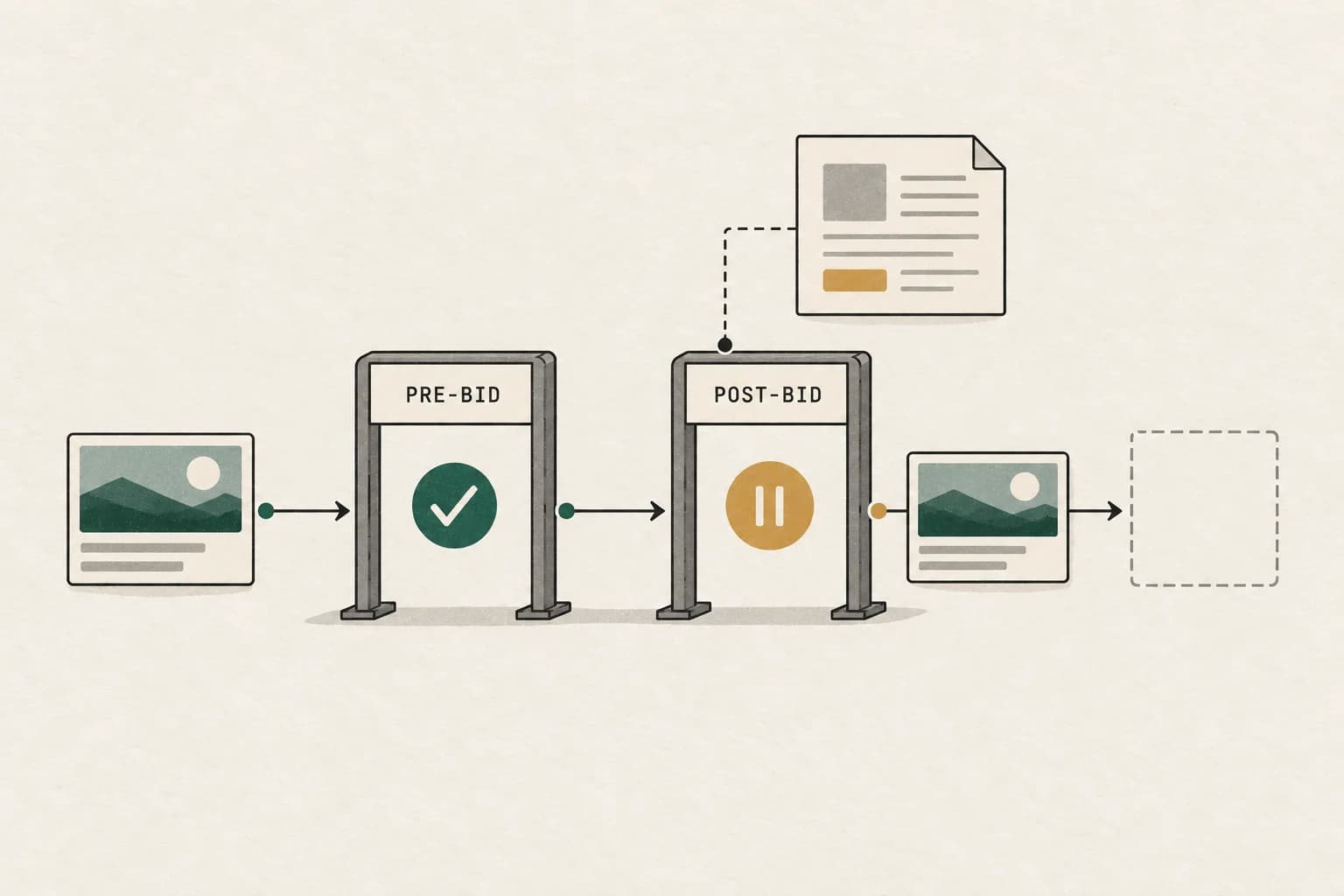
Pre-bid and post-bid describe stages, not identical tests#
A pre-bid control influences whether a buying system bids on an opportunity. It evaluates the information available at that stage under the configured targeting rules.
Post-bid verification evaluates delivery or the delivery context after purchase. Depending on the integration, a post-bid tag may measure, attempt to prevent the advertiser's creative from displaying, or record a later classification. “Post-bid” does not mean every decision happens after a human has seen the ad.
IAS documents a practical reason for using both stages: the URL supplied in the bid request may differ from the page its post-bid integration can identify. Its brand safety and suitability guidance also distinguishes blocking from monitoring and notes technical limitations. That is a vendor's description of its own approach, not proof of what happened in your campaign.
| Stage | Typical investigation question | Evidence to request |
|---|---|---|
| Bid eligibility | Why was this opportunity allowed to compete? | Effective pre-bid configuration and available inventory attributes |
| Ad delivery | Which creative and verification integration were used? | Tag versions, placement mapping, and delivery mode |
| Post-bid decision | What policy and information produced the result? | Reason code, effective policy, and observed context |
| Blocking action | What action did the integration actually take? | Block event and supported behavior for the format |
| Reporting | Which count and population appear in the export? | Metric definition, scope, processing status, and exclusions |
Treat these as evidence boundaries. A later block can reveal a policy mismatch, a context difference, an intentional stricter second check, or an integration problem. Its existence does not choose among those explanations.
Compare the two verification stages
Pre-bid and post-bid checks are not identical tests, and their labels do not show what a user saw. Discuss the evidence behind each result.
Discuss measurement optionsA short inquiry to scope relevant options; no campaign access is needed.
Translate failed, blocked, and unmeasurable carefully#
Verification labels are product-specific. Do not turn a glossary copied from an old forum comment into the official meaning of a current metric.
For operational purposes, separate three concepts:
- Classification: an observation was labeled as not meeting a stated requirement.
- Action: the integration attempted or performed a documented enforcement behavior.
- Observability: the integration had enough information to assess the requirement.
A report's “failed” label may describe a classification. “Blocked” may describe an action or a vendor-specific report category. “Unmeasurable,” “unrated,” and “unknown” can describe different kinds of missing information. Obtain the definition for each exported field, including whether its categories overlap.
IAS's explanation of monitoring versus blocking states that monitoring can report an issue while allowing delivery, whereas blocking applies an enforcement behavior under the client's settings. The presence of a vendor script on a page is therefore insufficient to prove that a blocking tag was configured for the displayed creative.
Use these questions with any provider:
For this exact report column:
- What event makes the counter increase?
- Is it a classification, an action, or a lack of information?
- Which impressions are eligible for the metric?
- Are blocked events included in failed events?
- Can one impression have multiple failure reasons?
- Does the count represent an attempt or confirmed enforcement?
- What should a user see in this format and integration?
- Which cases are unavailable or excluded from reporting?
Until those questions are answered, do not add failed and blocked totals together. If all blocked impressions are also failed, the sum double-counts them. If a single impression can fail geography and suitability, adding reason totals can also exceed the number of affected impressions.
Step 1: make the comparison reproducible#
Preserve the initial exports and settings before changing anything. Record the exact interval, time zone, export timestamp, campaign and placement IDs, creative versions, and report filters.
Match scope across the DSP, ad server, publisher, and verification provider. A DSP's purchased impressions, an ad server's served impressions, and a verification tag's inspected events can have different populations. A percentage becomes misleading when its denominator silently changes.
Create a compact incident summary:
| Field | Example of useful detail |
|---|---|
| Symptom | Increase in post-bid geo blocks on one inventory source |
| Start time | First affected reporting interval, with time zone |
| Scope | Campaign, line item, placement, creative, device, and format |
| Counts | Bid-eligible, purchased, verification-inspected, failed, blocked, unknown |
| Denominator | Explicit population used for each reported rate |
| Change history | New tag, segment, policy, SDK, publisher setup, or deal |
| Largest contribution | Source or placement with the most affected events |
This is a diagnostic worksheet, not a claim that every product exposes all these counts. Leave unavailable fields marked unavailable and ask what evidence can substitute for them.
If impressions also disagree between the ad server and measurement provider, complete the campaign delivery verification workflow alongside the block investigation. A missing receipt and a blocked ad need different fixes.
Step 2: compare effective policies field by field#
Two settings both called “brand safety” can apply materially different rules. Export the actual configuration, not only screenshots of top-level toggles.
Compare:
- Provider and exact pre-bid segment or profile ID.
- Post-bid account, campaign, and policy version.
- Selected content categories and risk levels.
- Inclusion and exclusion lists, including their versions.
- Country, region, or city targeting rules.
- Treatment of unrated or unidentified inventory.
- Monitoring versus blocking mode by format and placement.
- Effective dates, inheritance, overrides, and exceptions.
Check where a setting is inherited and where it can be overridden. Confirm whether every line item, creative, and deal received the same configuration at the same time.
Display & Video 360's brand suitability documentation describes advertiser-level settings, third-party verification options, and deal exemptions with specific scope limitations. Its treatment of unrateable impressions also illustrates why “not rated” is not the same as “classified safe” or “classified unsafe.” Apply the documentation for your actual buying platform and provider.
An illustrative mismatch would be a pre-bid segment excluding only high-risk content while the post-bid policy also blocks moderate-risk content. The resulting blocks may follow the configured rules. The remedy is an intentional policy decision or synchronization, not a technical workaround that suppresses the result.
Distinguish brand safety and brand suitability in the brief your teams share. Your company's suitability policy may exclude otherwise permissible content because it conflicts with the campaign's goals. Record that rationale so a publisher can understand the requirement without being accused of hosting inherently harmful content.
When the concern comes from a Google placement report, run the placement-report and control-scope audit. Identify the exact exclusion object, inherited scope and supported format before assuming a policy affected that placement.
Step 3: investigate unknown and invisible URLs#
A system that cannot establish the page context has a visibility limitation. It has not automatically proved that the content is unsafe, fraudulent, or unsuitable.
For web inventory, ask which URL the pre-bid system received and which context the post-bid integration could observe. Preserve the source of each field. A bid-request page value, an iframe URL, a top-level URL, and a reporting-domain field are different pieces of evidence.
Check whether the issue concentrates in a particular wrapper, iframe configuration, browser, player, app, or SDK version. Compare a permitted working test with a failing test on the same integration. Do not infer a hidden domain from a redirecting ad server's hostname.
Open Measurement access modes can affect available context. Google's IMA HTML5 Open Measurement guide states that a verification script in its documented limited mode cannot directly confirm the publisher domain and that provider support varies. Review the actual mode and supported integration before attributing an invisible-URL result to the publisher's content.
Use this triage table:
| Finding | Practical next action |
|---|---|
| Context absent in the bid request | Ask the supply and buying partners which field is required and supported |
| Expected context lost through a wrapper | Trace the configuration handoff and fix the supported integration |
| Restriction intentional for the environment | Document the limitation and agree how the policy treats unknowns |
| Provider reports a URL that differs from the expected page | Reproduce the case and request evidence of the observed context |
| Unknown inventory intentionally blocked by policy | Review the policy with its owner; keep unknown outcomes distinct |
Do not manufacture a top-level URL or insert a known publisher hostname into every event to avoid an unknown classification. That replaces a measurement limitation with incorrect evidence.
For supply-chain identity questions, use ads.txt, sellers.json, and supply-path checks. An authorized seller record and a verified page context answer different questions; one does not substitute for the other.
Step 4: separate geo rules from content rules#
A geo block does not necessarily indicate a content-suitability problem. Keep its investigation separate, even if both appear in one verification interface.
IAS's ad-blocker explanation lists geography, placement, content adjacency, and traffic source among possible reasons for an advertiser-requested block. That list does not identify which rule produced a specific event. Ask for the actual reason and the configured target.
Compare the geographic level and the evidence each system used. Country-level targeting is different from a city or postcode requirement. Unknown location is different from a location confidently outside the target. An IP-derived location does not by itself prove a person's physical presence at a precise address.
Request counts for in-target, out-of-target, and unknown outcomes if available. Then isolate the affected devices, apps, supply sources, and intervals. A sudden concentration on one streaming integration can have a different explanation from a stable disagreement between geographic databases.
Our location-verification guide covers the deeper diagnostic steps. If the issue involves CTV delivery counts as well, use the CTV discrepancy guide to distinguish beacon receipt from classification.
Step 5: reconcile a worked example without double-counting#
The following numbers are illustrative. They are not expected block rates, actual customer results, or financial liability calculations.
Suppose a campaign has 100,000 verification-inspected events in the agreed reporting interval. Its export shows:
| Report field | Count |
|---|---|
| Inspected events | 100,000 |
| Failed at least one policy check | 8,000 |
| Blocked events | 5,000 |
| Events with insufficient context | 4,000 |
It is tempting to claim 17,000 problematic events by adding the last three rows. That conclusion is unsupported until the provider explains their overlap.
Assume the provider confirms the following mutually exclusive partition:
| Reconciliation category | Unique events |
|---|---|
| Failed policy and blocked | 5,000 |
| Failed policy, monitored rather than blocked | 3,000 |
| Insufficient context, separate from the failed group | 4,000 |
| No issue recorded under the inspected checks | 88,000 |
| Total | 100,000 |
Now you can describe the data clearly: 8% failed a configured check, 5% were recorded as blocked, and 4% had insufficient context under a separate category. The 5% blocked rate is part of the 8% failure rate in this example, not an additional 5%.
The 88,000 remainder means no issue was recorded under the checks represented in this worksheet. It does not prove universal validity, attention, performance, or coverage of every possible risk.
Next, split the 5,000 blocked events by a documented primary reason or unique event identity. If multiple reasons can apply, retain the overlap table rather than pretending the reason counts form an additive waterfall.
This produces three operational tasks: verify policy alignment, investigate why monitoring applied to a subset, and resolve the context limitation. Each task has a different owner and acceptance test.
When a provider also quotes an invalid-traffic rate, audit the reviewed and campaign-wide denominators. Keep policy failures, recorded blocks, invalid classifications and unknown records separate before comparing percentages or requesting a financial adjustment.
Step 6: verify what blocking actually did#
Obtain a controlled reproduction for the actual format and supported environment. Record the creative selected, verification policy, result, and visible outcome. Ask the integration owner whether the tag replaced creative content, prevented a subsequent request, returned an alternative, or merely reported a classification.
Do not generalize across display, video, app, and CTV. Campaign Manager 360's ad-blocking FAQ describes format-dependent behavior, support limitations, and differences in reporting. That is an example of why “blocked impression” cannot be interpreted uniformly across platforms.
Test both expected-to-block and expected-to-allow cases. Confirm that allowed inventory still delivers and measures normally. For unknown-context cases, verify that the resulting action matches the documented campaign policy.
Where the vendor cannot expose the underlying record, preserve that verification gap. A screenshot of a blocked counter can support a reporting observation but cannot independently prove what appeared on a particular viewer's screen.
Choose a repair that preserves the campaign's requirement#
Use the confirmed cause to choose the change:
| Confirmed finding | Suitable response | Acceptance evidence |
|---|---|---|
| Pre-bid and post-bid policies differ unintentionally | Align the approved profile and inheritance | Exported effective settings and matched test outcomes |
| Verification configuration lost or stale | Repair trafficking or integration propagation | Correct version on affected placements |
| Context unavailable because of an implementation defect | Fix the supported signal path | Working test with receiver confirmation |
| Context unavailable by design | Document the limitation and agree inventory treatment | Support matrix and explicit policy decision |
| Specific source repeatedly violates the requirement | Adjust sourcing or targeting under the approved policy | Lower unique violations with stable measurement coverage |
| Report categories misunderstood | Correct the worksheet and reporting definitions | Reconciled unique counts |
A request to improve pacing is not automatically a decision to relax brand requirements. If a policy owner changes the rule, record the business rationale, scope, and effective date. That gives subsequent reports an honest interpretation.
Keep financial questions separate from the technical diagnosis. Whether a blocked event incurs media cost, serving fees, verification charges, credits, or dispute rights depends on the platform, format, integration, and applicable agreement. A block counter alone cannot calculate a refund.
A partner-ready evidence request#
Campaign, placement, creative, interval, and time zone:
Exact report fields and their current definitions:
Purchased / inspected / failed / blocked / unknown counts:
Overlap rules and denominator for each rate:

Pre-bid provider, profile, and effective configuration:
Post-bid provider, policy, tag version, and mode:
Inventory format, app/domain, device, player/SDK:
Relevant exceptions and policy-change timestamps:

Affected test event and available bid-time attributes:
Observed context and reason code:
Block action expected and action verified:
Receiver confirmation and reporting result:

Confirmed cause and accountable owner:
Proposed correction and verification plan:
Remaining unknowns:
Share only permitted diagnostic data. Remove authentication tokens, signed URLs, and unnecessary user or device identifiers from general escalation documents.
Frequently asked questions#
Does post-bid blocking mean the pre-bid vendor failed?
Not by itself. Compare the information, policy, coverage, and effective settings at each stage. A later check can use different context or intentionally apply a different rule. A reproducible implementation defect needs evidence beyond a blocked total.
Are failed and blocked impressions the same?
Do not assume so. Request the definitions for the exact fields and whether the categories overlap. Classification, action, and observability should remain separate in your investigation.
Should I stop blocking invisible or unrated URLs?
First determine why context is unavailable and whether the policy is operating as intended. Repair an integration defect where possible. If the limitation is inherent to the environment, the policy owner needs to decide how that inventory should be treated.
Does a block mean nobody saw any part of the ad?
That depends on the integration's timing and action. Ask for the supported behavior and a controlled test. The word “blocked” in an aggregate report does not independently establish the visible outcome of every event.
Should I remove post-bid protection if pre-bid is enabled?
Make that decision from documented coverage, campaign requirements, and observed outcomes. Removing a second control solely to eliminate an unexplained counter does not resolve the reason the counter increased.
Turn the discrepancy into an operating record#
The useful deliverable is a matched policy table, reconciled unique counts, a verified action for the affected format, and an owner for unresolved gaps. Those records prevent the same question from returning with the next campaign.
Continue with our brand-safety campaign workflow. Review AdProof's measurement approach and measurement workflows, or discuss a campaign review with your settings record and evidence worksheet.
Sources and research notes#
Researched on 25 October 2026. Examples, worksheets, and diagnostic categories are original illustrative material. No universal definition is asserted for proprietary “failed” or “blocked” fields. Use the current glossary and integration documentation supplied for your account.
- IAS: Approach to Brand Safety and Suitability.
- IAS: Commitment to Media Quality, including monitoring versus blocking.
- IAS: Ad-blocker explanation.
- Google Display & Video 360: Brand suitability and third-party verification settings.
- Google IMA HTML5: Open Measurement and access modes.
- Google Campaign Manager 360: Ad-blocking FAQ.
An inventory-sharing partner declaration needs its own request-to-file join. Use the seller-authorization investigation to check the partner domain, declared seller account and bid context without assuming that authorization proves traffic quality.
Compare the two verification stages
Pre-bid and post-bid checks are not identical tests, and their labels do not show what a user saw. Discuss the evidence behind each result.
Discuss measurement optionsA short inquiry to scope relevant options; no campaign access is needed.