
- Published
- Oct 26, 2026
- Updated
- Nov 1, 2026
- Reading time
- 16 min read
Ad Revenue Dropped but Traffic Stayed Stable? A Diagnostic Guide
Find where publisher ad revenue fell: compare page RPM, requests, responses, impressions, prices, consent paths, and empty slots with a practical audit.
In this guide (9 sections)
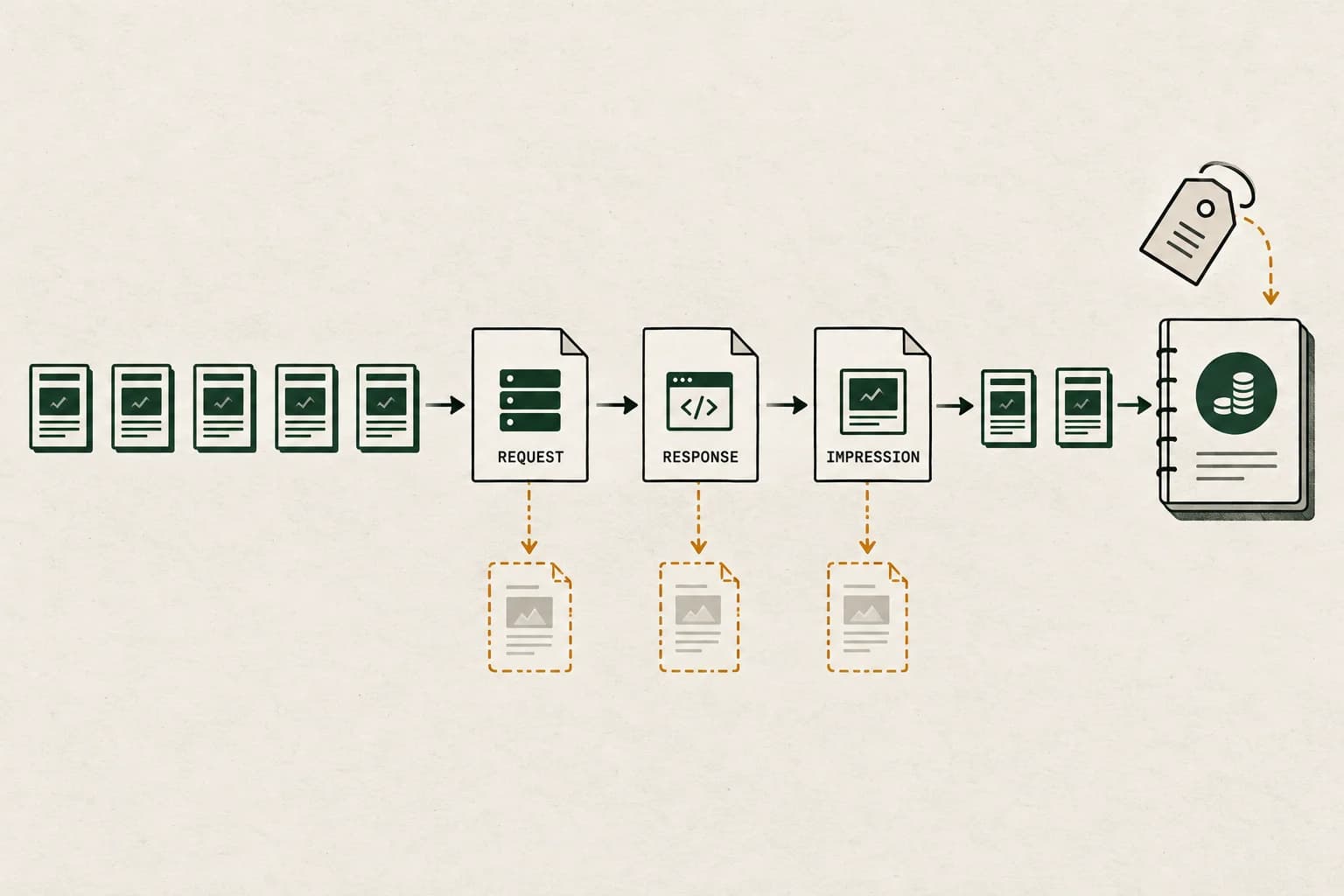
Stable traffic can coexist with falling ad revenue because visits are only the beginning of the monetization path. A page may make fewer ad requests, receive fewer eligible responses, record fewer impressions, or earn less per impression. Your first task is to find which stage changed, using comparable reporting periods and clearly named denominators.
A public publisher discussion about empty ad placeholders and declining revenue illustrates the question. The account-specific reports and competing explanations in that discussion are not independently verified causes. This guide provides a way to investigate your own evidence without assuming seasonality, bots, or a network failure.
Start with a five-number comparison#
Choose a completed period before the change and a comparable completed period afterward. Match weekdays, reporting time zone, currency, inventory scope, and revenue status. Do not compare finalized publisher earnings with another system's partial-day estimate.
Build a sheet with these five observations:
| Observation | Question it answers |
|---|---|
| Page views from a named source | Did comparable page activity change? |
| Ad requests for the selected inventory | Did the pages continue requesting ads? |
| Responses returning an ad, using the platform's definition | Did eligible demand continue returning ads? |
| Recorded impressions in the revenue basis | Did the selected response population produce counted delivery? |
| Revenue and its exact basis | Did the amount earned per counted impression change? |
Use metric names copied from the actual export. “Traffic,” “fill,” and “RPM” are not sufficient labels. Where a stage is unavailable, mark it unavailable rather than manufacturing a value from an unrelated total.
Google's current AdSense earnings troubleshooting guide similarly starts with page views, coverage, and impressions. Those are diagnostic checkpoints, not interchangeable measures of site popularity.
Trace the change through the ad path
Stable visits can mask changes in requests, eligible responses, impressions or yield. Discuss which stage your reporting can show.
Discuss measurement scopeA short inquiry to scope relevant measurement options; financial adjustments are not promised.
Page RPM and impression RPM answer different questions#
Page RPM is estimated revenue divided by page views, multiplied by 1,000. Impression RPM is estimated revenue divided by ad impressions, multiplied by 1,000. Google's RPM explanation and impression RPM definition distinguish the two bases.
A page can contain several ad opportunities, so a falling page RPM does not establish that the price of each ad impression fell. You may instead be recording fewer ad impressions per page.
Keep these distinctions visible:
| Label | Required denominator | Common mistake |
|---|---|---|
| Page RPM | The specified page-view count | Substituting sessions or users |
| Impression RPM | The specified ad-impression count | Treating requests as impressions |
| Matched-request eCPM | The named platform's matched requests | Comparing it directly with impression-based eCPM |
| Viewability rate | The relevant measurable impression population | Dividing by all site page views |
Ad Manager's Interactive report metric reference defines different request, response, impression, and pricing measures. Some are product-, report-, or account-specific. “Matched request” is not a universal synonym for a viewed, valid, or revenue-bearing impression.
If two partners use different revenue shares or include different revenue types, reconcile those first. More decimal places will not repair mismatched definitions.
When the question is choosing between partner offers, compare MCM fees, net revenue and reporting control using the same page population and fee basis.
A worked example: unchanged page views, revenue down 52%#
Hypothetical example. These are invented teaching figures, not AdProof customer results. Assume a single, comparable CPM display scope with one potential ad per request, no video pods or mediation branching, and consistently defined non-empty responses and recorded impressions.
| Observation | Before | After |
|---|---|---|
| Page views | 100,000 | 100,000 |
| Ad requests | 200,000 | 160,000 |
| Non-empty responses | 180,000 | 128,000 |
| Recorded impressions | 160,000 | 96,000 |
| Effective revenue per 1,000 recorded impressions | $5.00 | $4.00 |
| Estimated revenue, on the same reporting basis | $800 | $384 |
| Page RPM | $8.00 | $3.84 |
Revenue fell by $416, or 52%, despite identical page views. Four changes explain the arithmetic:
- Requests per page fell from 2.0 to 1.6.
- Non-empty responses per request fell from 90% to 80%.
- Recorded impressions per non-empty response fell from 88.89% to 75%.
- Effective revenue per 1,000 recorded impressions fell from $5 to $4.
For a consistently scoped example, the following is an accounting identity:
Revenue = page views
        × requests per page
        × non-empty responses per request
        × recorded impressions per non-empty response
        × effective revenue per recorded impression
The factors describe where the totals changed. They do not prove the cause. Fewer requests could reflect a template change, a different page mix, intentional lazy loading, or measurement coverage. A response-to-impression gap requires event-level evidence before it is called a rendering defect.
Do not turn this simplified example into a rule that every ad system has one response or impression per request. Video pods, mediation, and refresh introduce different counting relationships.
Investigate the first stage that changed#
1. Establish whether “traffic stayed stable” is a comparable observation
Separate page views, sessions, users, and server requests. A stable CDN request total may include automated activity that does not behave like a browser visit. Analytics may observe a different population because of consent or blocking.
For a web publisher comparing these two dashboards, reconcile AdSense Page views with the exact GA4 counters. A site-view count, an ad-displaying-page count and a linked publisher-ad impression report need separate checks before a yield explanation.
Export traffic by landing page or template, country, device, browser, and acquisition source. Compare the contribution of each segment, not only its percentage change. A tiny segment can double while having little effect on total revenue.
Also record changes to routing, analytics, bot controls, and consent configuration. If the traffic observer changed, first determine whether the apparent stability can be trusted. For event definitions, use our guide to impressions, reach, clicks, and conversions.
2. If requests per page fell, inspect the page before blaming demand
Check whether the expected ad slots and request logic are present on affected templates. Test initial navigation, a subsequent article, client-side navigation, and a return visit. An installation can work on the homepage while failing on the pages receiving paid or search traffic.
Compare release times with the first affected reporting bucket. Review tag loading, consent initialization, responsive size rules, and lazy-load triggers. In an authorized QA browser, compare a clean profile with the affected environment. A clean-profile success does not establish how all visitors experience the site. For a header-bidding page, audit Prebid and GPT lazy-loading handoffs to compare auction, targeting and request timing for the affected slot.
Capture one reproducible failing journey. Google's web ad-request troubleshooting guide explains how to preserve a network trace and inspect request, response, and asset-loading failures. Protect cookies, authentication data, and other sensitive fields before sharing a HAR file.
3. If requests remain stable but responses fall, check eligibility and the actual response
An empty visual slot does not identify which layer failed. The page may never have requested an ad, the server may have returned no eligible ad, or a creative may have failed after a response arrived.
Google's unfilled-impression guidance describes requests that returned no eligible ad. Use the affected ad unit and requested sizes to narrow the investigation. Review targeting, demand eligibility, inventory authorization, relevant account notices, and recent configuration changes with the owning team. If AdSense displays a serving restriction, audit the exact serving-limit notice separately from a single unfilled GAM request.
If the shift follows a Prebid video cache migration, compare the player and GAM request paths before attributing the result to demand. Restored playback and preserved request signals are separate acceptance checks.
Do not treat an HTTP 200 as proof of a rendered ad: inspect the response body and subsequent requests. Also check the relevant vendor's publisher status dashboard. An incident can guide the investigation; an absence of a listed incident does not prove your integration is healthy.
4. If a response exists but counted impressions fall, trace the handoff
A selected ad, injected creative code, loaded resources, and a counted impression occur at different boundaries. The GPT reference states that slotRenderEnded occurs when creative code is injected, before its resources have necessarily loaded. Its isEmpty field describes whether an ad was returned, not whether a person saw it.
For a bounded QA sample, keep the request time, response identifier where exposed, creative reference, resource outcomes, impression event, and receiver/reporting result together. Avoid copying sensitive tokens into a support ticket.
Some response-to-impression differences are expected. Google's Open Bidding FAQ lists possibilities including navigation away, prefetching, mediation competition, and video errors. The list is a set of hypotheses to test, not a diagnosis of your site.
Our ad-server impression discrepancy guide gives a deeper workflow for finding the first observation that differs between systems.
5. If counted delivery is stable, investigate the revenue basis and mix
Compare effective revenue at the same inventory grain. Use total revenue divided by its matching impression total, rather than averaging the eCPMs of differently sized segments.
When the comparison uses header-bidding data, reconcile Prebid and GAM bidder revenue with the same delivery population. A configured price bucket or line-item rate is a different monetary basis from the partner's revenue statement.
Split results by page group, country, device, format, demand channel, and any contract distinction that matters. A stable sitewide visitor total can hide a shift toward inventory with different prices. A lower blended price can arise from mix even when each comparable segment's price is unchanged.
Check estimated versus finalized status and the date each export was retrieved. Google's earnings explanation distinguishes estimated earnings, finalized amounts, payments, and balance. Keep documented adjustments separate from a technical impression-count investigation.
For an AdMob report-to-payment difference, reconcile estimates, finalized transactions and bank receipt. Confirm which ad sources share the payer, align the earning period and currency, then explain each transaction rather than assigning the entire difference to lost delivery or invalid traffic.
Seasonality is a possible explanation to test against comparable segments and history. It should not substitute for the missing request, impression, or revenue evidence.
Check consent, viewability, refresh, and supply without over-interpreting them#
Consent choices and data-processing modes can affect the delivery path and available demand. Google's guidance for non-personalized RTB requests describes privacy signals and restrictions for the covered buyer paths. Compare the same consent journey during QA and preserve the user's choice. Do not disable consent requirements to make a revenue graph recover.
If the publisher page reports a missing CMP or unexpected auction timing, separate Prebid API discovery from user-action timing. Capture the deployed build, first available interface and actual response sequence before attributing a revenue change to consent or increasing a timeout.
Review measurable coverage as well as viewability rates. A change in measurement coverage is not automatically a change in how many ads were visible. Likewise, lower viewability does not mathematically explain every drop in CPM revenue. Use the viewability reconciliation guide before comparing differently scoped rates.
Record refresh behavior separately from initial page requests. Google requires declarations that match refreshing inventory for the applicable buying paths. Increasing refresh or ad load is not a diagnostic substitute and can change the very population you are comparing. Use the refresh declaration and runtime audit to compare the actual trigger, fastest interval and targeted inventory with the applicable declaration. A loading delay should not silently stand in for that evidence.
If demand eligibility depends on supply authorization, review the actual relationship with the partner. Our ads.txt and sellers.json checklist explains how to investigate inconsistent records without assuming every unfamiliar seller is unauthorized.
A revenue drop is also not proof of invalid traffic. If quality filtering is suspected, request the exclusion categories and their population. Keep unsupported traffic, missing observations, duplicate events, and classified IVT separate, as explained in our IVT measurement guide.
If a traffic-quality rule now suppresses ad loading, evaluate a publisher gate before the first ad request. Reconcile withheld opportunities separately from requests received and later measurement exclusions.
An identity request has a CORS error: is that the revenue cause?#
A publisher reported an identity-envelope request failing with a CORS message while investigating lower revenue. One reply attributed it to a missing approved domain. That is a configuration hypothesis to verify, not an established explanation for the publisher's earnings.
MDN's explanation of the missing-origin-header error establishes a narrower fact: the cross-origin response lacks a permission header needed for the requesting page to access it. The console message does not establish why the response omitted that header, whether all identity requests fail, or how many ad opportunities depend on the affected path.
Separate the browser boundary from the provider's decision
In the Network panel, preserve one affected request's time, page origin, endpoint path/version, initiator, HTTP status and response headers where exposed. Record relevant privacy choices and whether this is a clean or returning browser profile. Keep identifiers, identity envelopes, consent strings and cookies out of public screenshots or tickets; send only the minimum necessary evidence through an agreed private channel.
If the browser does not expose a response body, mark it unavailable. Ask the integration owner for its corresponding server-side decision or request reference rather than inferring one from a generic console line.
LiveRamp's current ATS Envelope API documentation requires an origin approved for the placement. Its documented v2 responses distinguish several outcomes:
| Observed v2 status | Documented meaning to investigate |
|---|---|
| 200 | A successful response; inspect the documented envelope result |
| 204 | No-content outcome associated with opt-out or absent positive consent, including specified browser signals |
| 401 | The origin is not approved for the placement |
| 403 | The service is not configured for the endpoint |
| 451 | Country or consent restrictions prevent the response |
These are provider-specific meanings for the documented endpoint. The forum's example used an unversioned path. Confirm its implementation and applicable reference with the owner before applying the v2 table to that request. Do not change an endpoint version or replay a captured identity request merely because another URL appears in documentation.
Check the managed configuration and intended privacy behavior
If the relevant response establishes an origin problem, ask who owns the placement and whether the actual serving domain is included in its approved scope. LiveRamp's placement guidance describes domain and region configuration and review when adding them. A publisher using a managed integration should obtain confirmation from that integration's owner rather than assume access to the provider's settings.
Also verify whether the request was expected for that consent and geographic context. LiveRamp's installation and testing guide specifies supported locations and CMP loading order. It explains that pending placements can operate in test mode using mocked envelopes. A mock result proves a limited test path, not production identity availability or additional revenue.
Preserve opt-outs and browser privacy preferences during diagnosis. Do not make a privacy-restricted no-content response look successful by removing the relevant signal. Nor does adding a permissive response header to your own website fix a third party's response. A request made with no-cors produces an unreadable response, so it does not supply the envelope the application needs.
Measure the affected population before attaching a dollar figure
Connect the identity finding back to the same request-to-revenue stages used earlier. Ask which templates, browsers, regions and consent journeys encounter it, and whether the downstream auction continues with an allowed alternative path. Identity availability, eligible demand, counted impressions and revenue are separate observations.
Hypothetical diagnostic example: a reviewed QA sample has 1,000 explicitly defined ad opportunities. Of these, 300 make the relevant identity request and 90 receive a confirmed configuration error. That is 30% of the selected identity-request population and 9% of the opportunity sample. It is not proof that 9% of impressions were lost, that those requests were fraudulent, or that earnings would rise by 9% after a repair. Multiple identity calls or opportunities per page would require a different join and denominator.
After an approved correction, repeat the matched browser and privacy scenarios, then compare completed production cohorts while recording other changes. A disappeared console error is evidence about the technical symptom. A revenue-effect claim needs the additional auction, delivery and commercial evidence. Use the independent-measurement comparison guide to keep the observation boundary and its limits explicit.
Send a support packet that can produce a specific answer#
Ask the partner to identify the first changed boundary and its evidence. Include:
- The selected dates, time zone, currency, inventory scope, and export timestamps.
- Before-and-after counts for pages, requests, responses, impressions, and revenue, with exact metric names.
- The largest affected page, ad unit, device, and geographic segments.
- A change log covering deployment, consent, targeting, demand, and reporting changes.
- One timestamped failing QA journey, sanitized network evidence, and a comparison that succeeds.
- Account notices and relevant incident references, without assuming either explains the whole drop.
Request a named next investigation, its owner, the evidence still needed, and the next review date. Keep any proposed configuration change separate from the diagnosis, with a rollback plan and a way to assess its effect.
Frequently asked questions#
Can revenue fall if page views and impressions are unchanged?
Yes. Effective revenue per counted impression or the revenue basis can change. Check currency, estimates versus finalization, inventory mix, contract treatment, and matching price measures before assigning a cause.
Does a blank placeholder always mean no fill?
No. It is a visual symptom. A missing request, empty response, resource failure, or layout issue can leave space without a visible ad. Trace the specific journey and inspect the response rather than diagnosing from a screenshot alone.
Does an identity-provider CORS error prove why revenue fell?
No. It identifies a browser response-access problem. Confirm the provider's decision and applicable endpoint, the affected request population, and what happened afterward in the auction and delivery path. An approved-origin issue can be a real defect without establishing the size or cause of a sitewide earnings decline.
Should I add more ads while investigating?
Not as the first response. Changing ad load or refresh changes requests per page and makes the original comparison harder to interpret. Establish the changed boundary before testing a documented, reversible configuration change.
Can independent measurement prove the amount a publisher should be paid?
A separate observation can help reconcile supported delivery and quality measures. Payment still depends on the relevant agreement, accepted measurement basis, revenue status, and any documented adjustments. Missing coverage should remain visible.
Bring a defined discrepancy to the next review#
Start with comparable counts and one reproducible journey. If you need help assessing a supported measurement scope, talk to AdProof about the evidence you have and the boundaries that remain unobserved. Independent measurement is useful when it makes a discrepancy explainable, with its limits intact.
Trace the change through the ad path
Stable visits can mask changes in requests, eligible responses, impressions or yield. Discuss which stage your reporting can show.
Discuss measurement scopeA short inquiry to scope relevant measurement options; financial adjustments are not promised.